
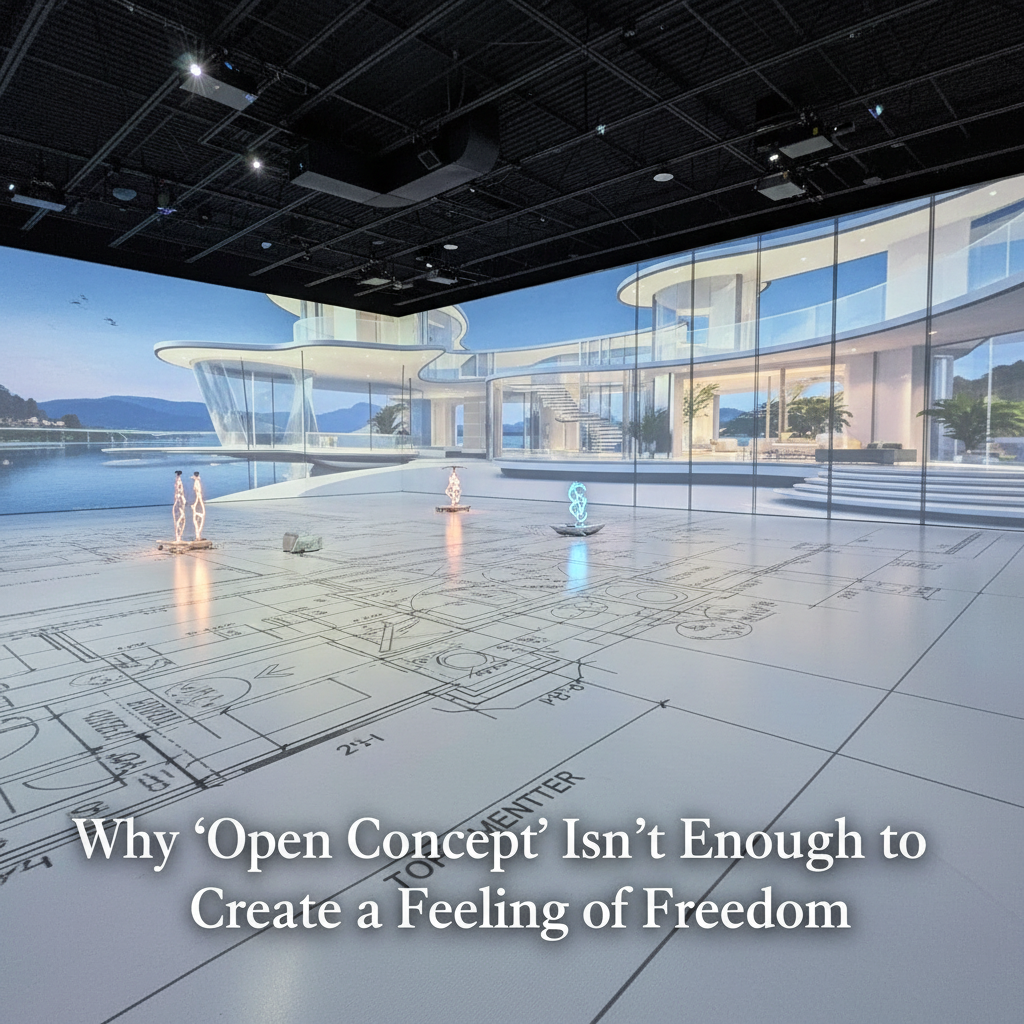
“Open concept” has become the gold standard in modern design.
Remove walls. Expand sightlines. Create one continuous space.
It’s often marketed as the definition of luxury living.
But here’s the reality most people discover too late:
Open concept alone does not create a feeling of freedom.
At The BluView, we’ve seen countless projects where walls were removed, square footage increased, and yet—the space still felt tight, uncomfortable, or underwhelming.
Because freedom in design is not about openness alone. It’s about how that openness is experienced.
The Misconception Behind Open Concept Design
The assumption is simple:
More open space = more freedom.
But that equation is incomplete.
An open space without structure, proportion, and flow can feel:
- Empty rather than expansive
- Exposed rather than comfortable
- Disconnected rather than cohesive
This is one of the most common misunderstandings in modern architecture.
Openness without intention does not create luxury—it creates imbalance.
Why Some Open Spaces Still Feel Tight
You’ve probably walked into a large open space that somehow felt… restricted.
That feeling usually comes from subtle design issues such as:
- Ceiling heights that don’t match the scale of the room
- Poor proportions between width, length, and height
- Lack of defined zones within the space
- Awkward transitions between areas
Even without walls, these elements can create a sense of compression.
This is why many so-called open layouts fail to deliver a true spatial freedom experience.
The Role of Proportion in Creating Real Openness
Proportion is what your eye and body respond to instantly.
In high-end design, proportions are carefully calibrated so that:
- The ceiling height supports the footprint of the space
- Open areas feel balanced, not overwhelming or cramped
- Every dimension relates harmoniously to the next
When proportions are right:
- The space feels calm and expansive
- Movement feels natural
- The environment feels elevated
When they’re wrong:
- The space feels off—even if you can’t explain why
This is where true architectural precision replaces generic open layouts.
Ceiling Height: The Most Overlooked Luxury Factor
One of the biggest drivers of perceived freedom is vertical space.
You can have a wide open floor plan—but if the ceiling height is too low relative to the footprint, the space will feel compressed.
Higher ceilings, when used correctly:
- Create a sense of air and openness
- Enhance natural light distribution
- Elevate the entire experience
But it’s not just about making ceilings higher—it’s about making them proportionate.
This is a key element in achieving luxury architectural flow.
The Importance of Defined Zones Within Open Spaces
True freedom doesn’t mean everything blends into one undefined area.
It means each part of the space has purpose—while still feeling connected.
High-end open designs create subtle zones through:
- Changes in ceiling height
- Strategic lighting
- Material transitions
- Furniture placement
These zones:
- Guide movement
- Improve functionality
- Create comfort within openness
Without them, the space feels chaotic rather than liberating.
Transitions: Where Most Open Concepts Fail
One of the biggest mistakes in open design is ignoring transitions.
When spaces flow into each other without intention, you lose rhythm.
Strong transitions:
- Create a sense of progression
- Add depth and dimension
- Make the space feel curated
Weak transitions:
- Make everything feel flat
- Remove hierarchy
- Reduce emotional impact
This is where many open layouts fall short—they remove walls, but don’t replace them with meaningful design transitions.
Designing for Experience, Not Just Layout
The biggest shift in modern design is moving from layout-focused thinking to experience-focused thinking.
Instead of asking:
“Does this look open?”
You should be asking:
“Does this feel open?”
That means considering:
- How the body moves through the space
- How light interacts with surfaces
- How proportions affect perception
- How each area connects to the next
This is the foundation of true immersive architectural design.
Why Visuals Alone Are Misleading
Renderings and plans often make open spaces look impressive.
But they don’t capture:
- Scale in real life
- Movement and flow
- Emotional response
That’s why many clients approve designs that look incredible—but feel disappointing once built.
The only way to truly evaluate openness is through experiential validation.
The BluView Approach to True Spatial Freedom
At The BluView, we go beyond the concept of “open.”
We focus on:
- Creating balanced proportions
- Designing intentional transitions
- Enhancing vertical and horizontal flow
- Validating how spaces feel before construction
Because our goal is not just to open up a space—it’s to elevate it.
Rethinking What Luxury Really Means
Luxury is not about removing boundaries.
It’s about designing them intelligently.
A truly luxurious space:
- Feels expansive without being empty
- Feels structured without being restrictive
- Feels natural without being accidental
That balance is what creates real freedom.
The Takeaway
Open concept is just the beginning.
If you want your space to feel truly free, you need:
- Proportion
- Height
- Flow
- Transitions
- Experience
Because in the end, freedom isn’t about how much space you have.
It’s about how that space makes you feel.