
When a project runs into trouble, most people blame construction.
They blame labor shortages.
They blame material delays.
They blame subcontractors.
But the truth is more uncomfortable — and more important.
Most projects don’t fail during construction.
They fail before it ever begins.
At The BluView Experience, we’ve seen it repeatedly. The chaos that shows up on-site usually starts in preconstruction — in small moments of misalignment, overlooked assumptions, and decisions made without full clarity.
The Illusion of a “Good Set of Plans”
Architectural drawings can be technically correct and still lead to problems. Dimensions may meet code. Layouts may function on paper. Everyone may sign off.
But beneath the surface, subtle misalignments often exist:
• The client imagines something different than the architect
• The builder interprets circulation differently than the designer
• A planning board struggles to visualize impact
No one notices the gap — until it becomes concrete.
Construction simply exposes what was misunderstood earlier.
Small Misalignment Becomes Expensive Reality
A hallway feels tighter than expected.
A kitchen island disrupts flow.
A lobby lacks the presence stakeholders anticipated.
Each issue may seem minor, but together they compound into change orders, redesigns, tension, and delays.
These aren’t construction failures.
They are clarity failures.
And clarity is created before ground is broken.
The Psychology of Assumption
Preconstruction decisions often happen quickly. Meetings move fast. Plans are reviewed on screens. Approvals are granted based on trust and experience.
But human psychology plays a role. When we look at 2D drawings, our minds fill in the blanks. We imagine proportions. We assume scale. We trust instinct.
The problem is that imagination varies from person to person.
When construction starts, reality replaces imagination — and that’s when differences appear.
Chaos Is a Symptom, Not the Cause
When a project feels chaotic mid-build, it’s rarely because someone lacked skill. More often, it’s because something wasn’t fully understood at the start.
Late-stage friction between trades, client hesitation, approval setbacks — these are symptoms of earlier uncertainty.
BluView addresses the root, not the symptom.
Turning Assumption Into Shared Experience
The solution isn’t more meetings. It’s not more emails or markups.
It’s experience.
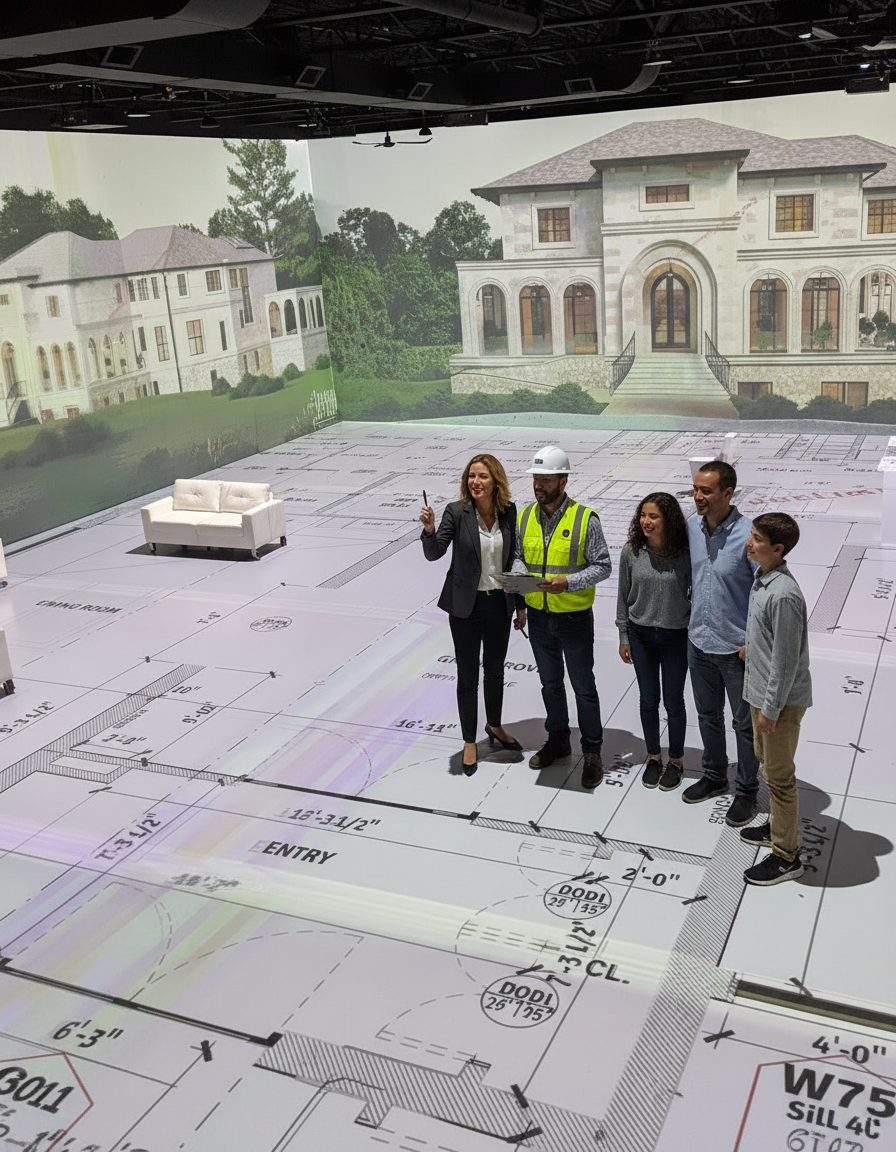
When architects, builders, and clients step into a project at full scale, interpretation disappears. Everyone sees the same proportions. Everyone feels the same circulation. Everyone understands the same reality.
That shared understanding eliminates the psychological gap between paper and built space.
Approval Confidence Begins Early
Municipal boards and stakeholders also struggle when reviewing plans abstractly. When something feels unclear, hesitation increases. When hesitation increases, approvals slow.
Experiencing a project physically at 1:1 scale builds confidence — not just for internal teams, but for external decision-makers.
Confidence accelerates approvals. Clarity reduces resistance.
Prevention Is Always Cheaper Than Correction
Every project has a critical moment — the point where decisions become permanent. If clarity exists at that moment, the build flows smoothly.
If uncertainty exists, correction becomes expensive.
BluView creates a controlled environment to uncover issues before they turn into commitments. Walls can shift. Layouts can adjust. Proportions can be tested — without financial consequence.
Prevention is strategy. Correction is damage control.
Leadership in Design Is About Timing
The most strategic teams understand that leadership isn’t about reacting quickly. It’s about acting at the right time.
Preconstruction is the most powerful stage of any project. It’s the moment where risk is lowest and flexibility is highest.
Using that stage wisely determines what happens months later on-site.
Build From Alignment, Not Assumption
Successful projects share one thing in common: alignment before execution.
At The BluView Experience, we help teams eliminate ambiguity before construction begins. We replace imagination with experience, assumption with clarity, and uncertainty with confidence.
Because projects don’t fail during construction.
They fail when clarity is missing before it.
Walk it first.
Align it early.
Build it right.