
Every architect knows the feeling.
Hours turn into days. Days turn into weeks. Floor plans evolve, elevations shift, and countless design revisions slowly shape a project from concept into something that looks convincing on paper. The drawings look right. The renderings are beautiful. The proportions seem balanced.
But there is always a quiet question in the back of every architect’s mind.
Will this actually work in real life?
Because architecture does not live on paper. It lives in space, movement, proportion, and experience. The true test of a design is not how it looks on a screen, but how it feels when someone walks through it.
That moment — when a design moves from a drawing to a real spatial experience — is the moment everything changes.
The Hidden Gap Between Drawings and Reality
Architectural drawings are powerful tools. Floor plans, elevations, and 3D renderings help translate ideas into visual communication. They allow architects, developers, and clients to understand the concept of a space.
But drawings still have limitations.
A 2D floor plan cannot fully communicate scale, circulation, spatial relationships, or human perception. Even advanced 3D models and renderings cannot replicate the feeling of standing inside a room and experiencing the architecture around you.
This gap between representation and reality is where many costly design problems begin.
A hallway that looked wide enough on a plan suddenly feels narrow.
A kitchen island blocks the flow of movement.
A living room that looked generous on paper suddenly feels compressed.
These are not drafting mistakes. They are human spatial perception issues — something that drawings alone cannot always reveal.
And this is why the most important moment in modern architectural design happens when someone finally walks through the project at full scale.
The Aha Moment That Changes Everything
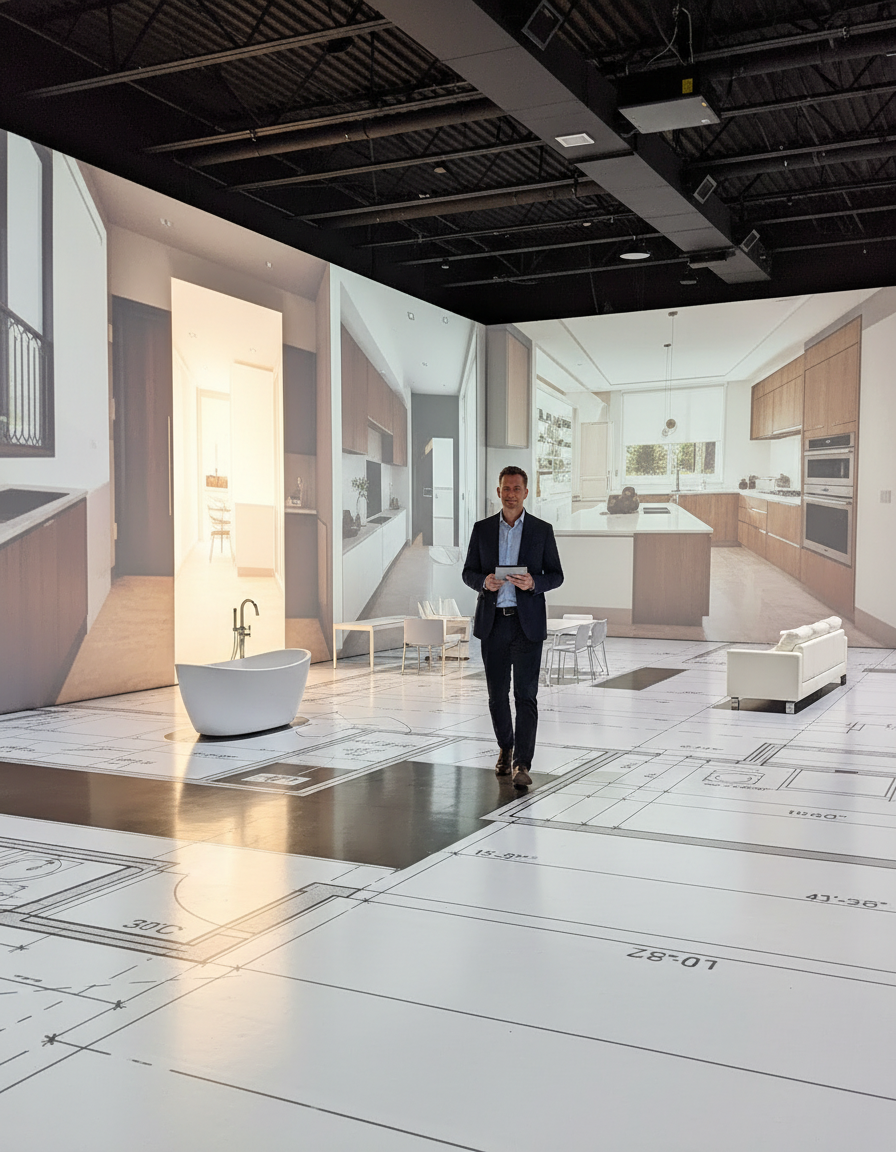
When architects step into a full-scale walkthrough of their project, something remarkable happens.
The design stops being theoretical.
Walls suddenly feel real. Distances become clear. Sightlines emerge. Circulation paths reveal themselves naturally. Doors, windows, and furniture placement suddenly interact with the human body in ways drawings cannot fully communicate.
This is the moment architects often stop mid-step and say something like:
“Wait… this actually works.”
Or sometimes:
“We need to move that wall.”
And that moment — whether it confirms the design or improves it — is one of the most valuable steps in the architectural process.
Because discovering spatial truths before construction begins is what prevents expensive surprises later.
Why Spatial Experience Matters More Than Perfect Drawings
Great architecture is not measured only by how it looks. It is measured by how it functions, flows, and feels.
The best designs consider:
- Human circulation patterns
- Sightlines and spatial orientation
- Proportion and scale perception
- Lighting and openness
- Interaction between rooms and transitions
These qualities cannot be fully evaluated through drawings alone.
They must be experienced physically.
This is why the architectural industry is increasingly embracing full-scale architectural walkthroughs, immersive design visualization, and spatial simulation environments as part of the design validation process.
It allows architects to test their ideas in the same way engineers test structural systems — by seeing how they perform in real conditions.
From Design Confidence to Client Confidence
There is another powerful moment that happens during a walkthrough.
The client sees the project clearly for the first time.
Architects often understand their designs deeply because they live inside the drawings for months. But clients usually see only fragments — renderings, plans, and presentations.
When clients step into a life-size walkthrough environment, their understanding changes instantly.
They no longer need to imagine the space.
They can walk through the living room, stand in the kitchen, experience the hallway width, and feel the scale of the bedrooms.
Suddenly, design conversations become faster and more productive.
Questions that once required long explanations become obvious within seconds. Decisions become easier. Revisions become smarter.
This clarity transforms the relationship between architects and clients from interpretation to shared understanding.
Eliminating Costly Design Surprises
One of the biggest financial risks in construction is discovering design issues after building begins.
Late-stage design changes can cause:
- Expensive change orders
- Construction delays
- Frustration between teams
- Rework of completed elements
- Budget overruns
By walking through a project before construction starts, architects and developers can identify issues early and make adjustments quickly.
This process helps:
- Reduce construction risk
- Improve design confidence
- Strengthen client alignment
- Protect project budgets
- Accelerate decision making
In other words, a few hours of spatial validation can prevent weeks or months of costly redesign later.
The Future of Architecture Is Experiential
Architecture is evolving.
For decades, the design process relied heavily on drawings, models, and renderings. While those tools remain essential, the industry is now recognizing the power of immersive architectural experiences.
Architects are increasingly integrating full-scale walkthrough technology, spatial visualization environments, and experiential design validation into their workflow.
This shift is not about replacing creativity or design intuition. It is about strengthening it.
When architects can experience their own designs physically, they gain deeper insight into spatial quality, circulation flow, and human interaction with architecture.
And that leads to better buildings.
The Moment That Changes Everything
There is a quiet but powerful moment during a walkthrough.
The architect pauses. Looks around. Walks a few more steps.
And then smiles.
Because the proportions feel right. The rooms connect naturally. The circulation flows effortlessly.
The design works.
That moment is not just satisfying — it is transformative.
It turns uncertainty into confidence.
It turns drawings into architecture.
And it reminds everyone involved why great design is not just something we draw.
It is something we experience.
Experience Your Design Before It Becomes Reality
At The BluView, architects, developers, and builders can step inside their projects through full-scale architectural walkthroughs and immersive spatial visualization.
Instead of imagining the space, you can walk through it, test it, refine it, and perfect it before construction begins.
This process helps teams:
- Improve design clarity
- Reduce construction risk
- Align clients and architects
- Identify spatial improvements early
- Build with confidence
Because the best moment in architecture is not when the drawings are finished.
It is when you realize the design truly works.
Visit The BluView
📍 The BluView Experience
156 Route 59, Suffern, NY 10901 – Unit B4
📞 Phone: (845) 533-4473 Ext. 101
🌐 Website: www.thebluview.com
📷 Instagram: @thebluview_experience
Schedule a walkthrough and experience your design before it becomes reality.