
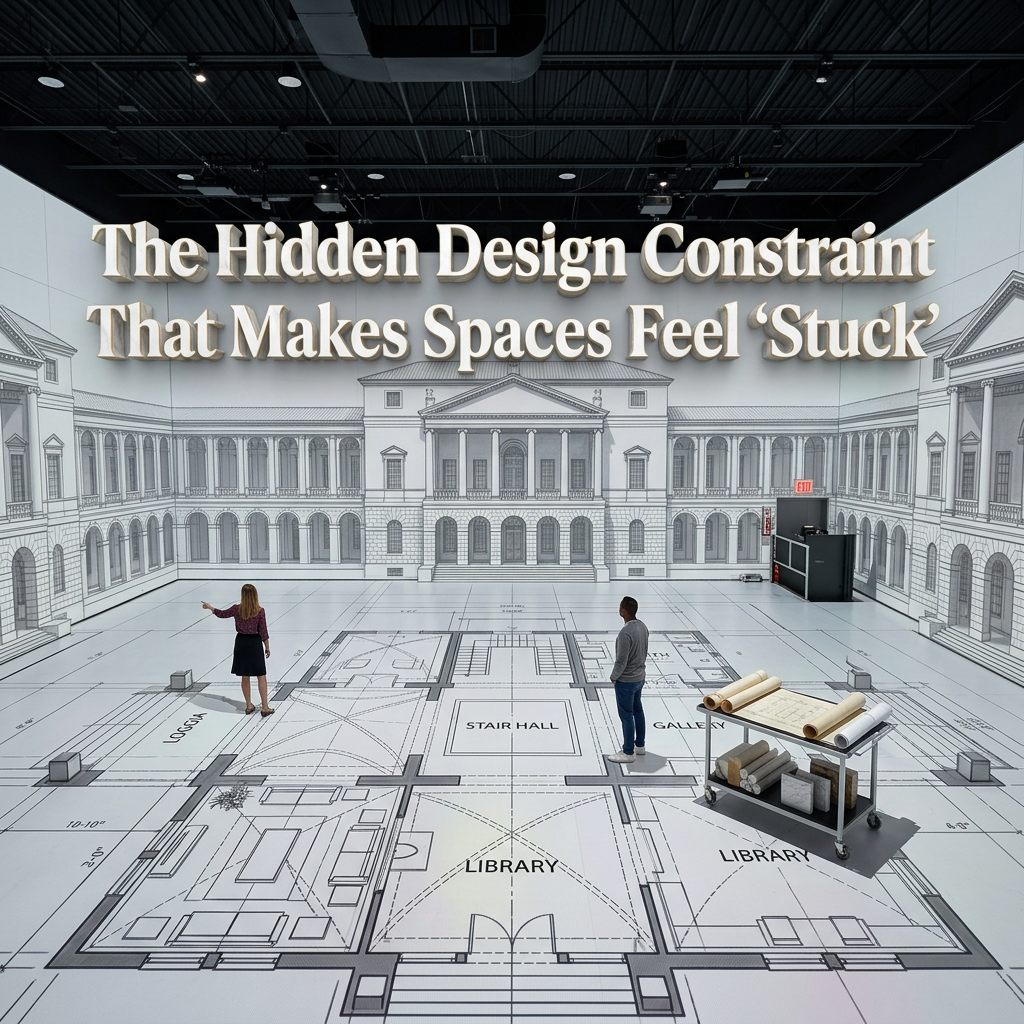
Most people assume that when a space feels tight, the problem is size.
Not enough square footage. Not enough openness. Not enough room to breathe.
But here’s the truth:
The problem isn’t your space—it’s how your space moves.
At The BluView, we’ve seen large, expensive projects feel restrictive… and smaller, more intentional spaces feel completely open and effortless.
The difference is not in the dimensions.
It’s in the flow.
Why Some Spaces Feel Stuck—No Matter the Size
You can walk into a 5,000 sq ft home and still feel constrained.
Why?
Because movement is blocked—not physically, but experientially.
This happens when:
- Spaces don’t connect naturally
- Transitions feel forced or unclear
- The sequence of rooms interrupts movement
- The layout lacks rhythm
This is the hidden constraint most people miss: poor layout sequencing.
The Concept of Spatial Sequence
Every space tells a story.
Not visually—but through movement.
As you walk through a well-designed environment, there’s a natural progression:
- Entry leads to transition
- Transition leads to openness
- Openness leads to focus
Each moment flows into the next.
This is called spatial sequencing, and it’s one of the most important elements in high-end design.
When it’s done right, you don’t notice it.
When it’s wrong, you feel stuck.
How Poor Sequencing Traps Movement
When layout sequencing is off, the experience breaks down.
You may feel:
- Hesitation when moving between spaces
- Confusion about direction
- Interruptions in flow
- A lack of continuity
Even if the space is large, these issues create a sense of limitation.
It’s like being in a maze instead of a journey.
This is one of the most overlooked architectural flow problems in modern design.
The Illusion of Square Footage
More space doesn’t automatically mean more freedom.
In fact, without proper sequencing, more space can amplify the problem.
You end up with:
- Larger disconnected areas
- More awkward transitions
- Increased inefficiency
This is why some compact spaces feel luxurious—because they are designed with intention.
And some large spaces feel frustrating—because they are not.
Designing Movement, Not Just Rooms
Most layouts are designed as collections of rooms.
But great design is not about rooms—it’s about movement.
Instead of asking:
“Where should this room go?”
You should be asking:
“How does someone move through this space?”
That shift changes everything.
It transforms static layouts into dynamic experiences.
The Role of Transitions in Unlocking Flow
Transitions are where movement either flows—or breaks.
Strong transitions:
- Guide the user naturally
- Create a sense of progression
- Connect spaces seamlessly
Weak transitions:
- Interrupt movement
- Create friction
- Make spaces feel disconnected
This is where many layouts fail—not in the rooms themselves, but in how they connect.
Breaking Free from Design Limitations
Passover is about leaving limitations behind.
And in design, limitations often come from unseen constraints.
Not walls—but poor flow.
Not size—but sequencing.
Not layout—but experience.
To create a sense of freedom, you need to:
- Align spaces in a logical sequence
- Eliminate unnecessary interruptions
- Design transitions with intention
- Prioritize movement over structure
This is how you turn restriction into flow.
Why Visual Planning Isn’t Enough
Plans and renderings can’t fully capture movement.
They show structure—but not experience.
That’s why many layouts look perfect on paper… but feel completely different in reality.
To truly understand flow, you need to experience it.
This is where immersive design validation becomes essential.
Experiencing the Space Before It Exists
When you walk a space before it’s built, everything becomes clear.
You can feel:
- Where movement slows down
- Where transitions fail
- Where the space opens—or closes
This is the fastest way to identify hidden constraints.
And it’s the difference between guessing and knowing.
The BluView Approach to Unlocking Flow
At The BluView, we focus on what most people overlook:
How a space actually moves.
We help clients:
- Identify hidden flow constraints
- Refine layout sequencing
- Validate movement before construction
- Create spaces that feel natural and unrestricted
Because the goal isn’t just to build—it’s to create an experience that feels effortless.
The Real Definition of Freedom in Design
Freedom is not about having more space.
It’s about removing resistance.
A truly well-designed space:
- Flows without friction
- Connects without confusion
- Feels open without being empty
That’s what creates the feeling of ease, clarity, and luxury.
The Takeaway
If your space feels stuck, don’t assume it’s too small.
Look deeper.
The issue is likely hidden in how your layout is sequenced.
Fix the flow—and you unlock the space.
Because in the end, the best designs don’t just give you space.
They give you freedom to move through it effortlessly.