
It was supposed to be a simple confirmation session.
The plans were finalized.
Permits were almost ready.
The builder was preparing schedules.
The client just wanted to “take one last look.”
Two hours later, everything changed.
Not because the design was bad.
Not because the architect made a mistake.
But because, for the first time, the client was standing inside the space at full scale.
And that changes everything.
At The BluView Experience, this moment happens more often than people expect.
The Paper Looked Perfect
On the architectural drawings, the layout was clean.
Open-concept kitchen.
Generous living space.
Well-proportioned hallway.
Spacious primary suite.
On paper, it worked beautifully.
The square footage made sense.
The dimensions were technically correct.
The renderings looked stunning.
Everyone approved it.
Until the client walked it.
The Aha Moment
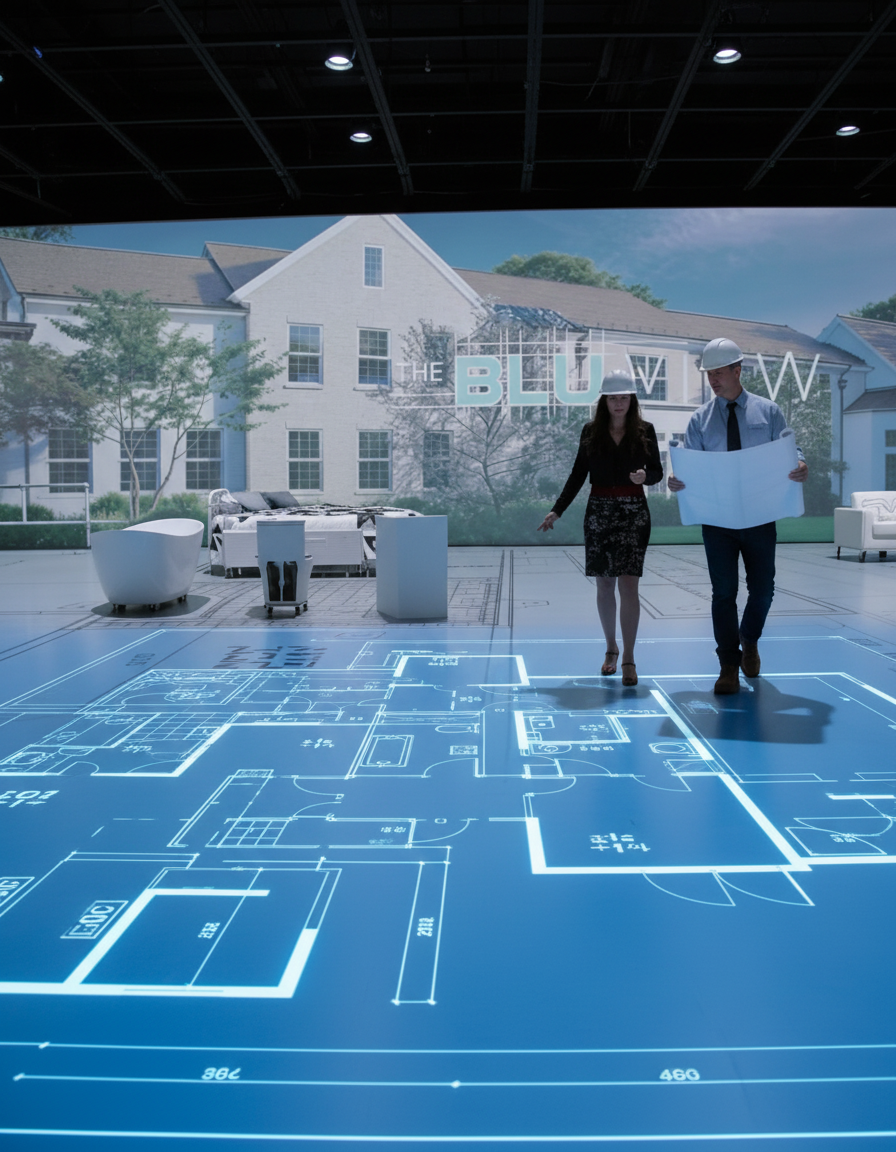
As the full-scale 1:1 projection illuminated the room boundaries, the client began walking through the kitchen into the living area.
They paused.
“It feels closer than I imagined.”
Nothing was wrong numerically.
But spatially?
It felt different.
The island clearance was technically compliant — but emotionally tight. The transition between dining and living was functional — but not fluid.
And suddenly, the conversation shifted from theory to reality.
Experience Changes Perception
This is the difference between reviewing a 2D floor plan and walking a full-scale design validation session.
On paper, your brain fills in the gaps.
In real space, your body tells the truth.
You feel:
• Circulation flow
• Room proportion
• Ceiling perception
• Sightline impact
• Entry experience
The client realized that if they didn’t widen the transition now, they would feel that tightness every single day after construction.
And once built, that adjustment would cost tens of thousands.
A Small Change That Saved Big Money
During that same walkthrough, the client also tested:
• Furniture placement in the living room
• Closet access in the primary suite
• Office door swing clearance
• Hallway width with imagined traffic flow
Three minor layout adjustments were made that afternoon.
On paper, they looked small.
In construction cost?
They would have been major change orders.
Because those decisions were made before framing began, the cost of adjustment was minimal.
That is the power of preconstruction spatial validation.
Emotional Clarity Is Priceless
But the biggest shift wasn’t financial.
It was emotional.
At the beginning of the session, the client was anxious. Building a custom home is one of the largest investments most families ever make.
By the end of the walkthrough, their tone changed.
They weren’t guessing anymore.
They weren’t hoping the space would feel right.
They knew.
Confidence replaced uncertainty.
And confident clients make better decisions.
Why These Moments Are Trending in 2026
In today’s construction market, projects are larger, budgets are tighter, and timelines are more aggressive.
Developers and homeowners are realizing that:
• Change orders destroy margins
• Miscommunication slows timelines
• Spatial mistakes are expensive
• Emotional regret lingers
Full-scale walkthrough technology is becoming a critical step in luxury residential design planning and commercial development strategy.
Because the earlier you experience the space, the cheaper and easier it is to refine it.
Architects and Builders Benefit Too
This wasn’t just a win for the client.
The architect left the session with stronger clarity.
The builder gained confidence in final dimensions.
The entire team aligned around one shared physical reality.
Instead of revisiting decisions during construction, they locked them with certainty.
Fewer surprises.
Fewer revisions.
Stronger collaboration.
The Pattern We See Every Week
“The kitchen feels tighter than I expected.”
“The hallway should be wider.”
“Let’s shift that wall six inches.”
“The entry needs more presence.”
These are not dramatic design failures.
They are human reactions to real space.
And when those reactions happen during a full-scale walkthrough — before construction — they are opportunities.
When they happen after framing, they are expenses.
The Moment Before It Becomes Permanent
There is always a window.
A moment when walls are still flexible.
When layouts can still evolve.
When changes are strategic instead of costly.
That moment is before the first nail meets concrete.
At The BluView Experience, we help clients capture that moment.
We turn architectural drawings into lived experience.
We eliminate interpretation gaps.
We reduce costly change orders.
We protect construction budgets.
Because the most important design decisions don’t happen at the drafting table.
They happen the day the client walks inside their future space — and sees it clearly for the first time.
And sometimes, that’s the day everything changes.