
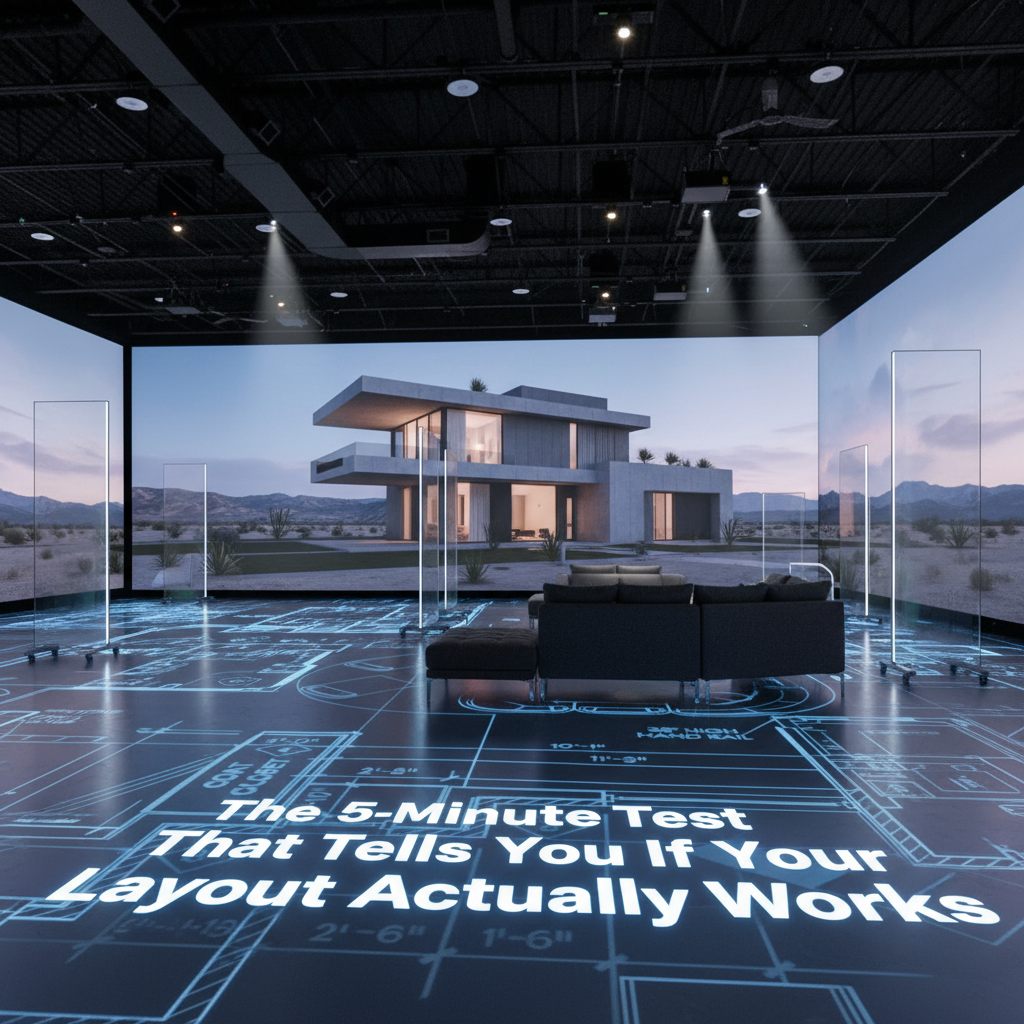
Most layouts don’t fail on paper.
They fail in reality.
You can review plans for hours, analyze dimensions, approve layouts, and still end up with a space that feels… off. Not because the design is wrong—but because it was never truly tested.
At The BluView, we rely on one simple principle:
If a layout works, you’ll feel it within minutes. If it doesn’t, you’ll feel that too.
Why Layouts Look Better Than They Perform
Architectural layouts are designed to be logical. Clean lines, aligned rooms, efficient use of space.
But real life isn’t lived in plans—it’s lived in motion.
That’s where the disconnect happens.
A layout can:
- Look spacious on paper but feel tight in reality
- Seem efficient but disrupt natural movement
- Appear balanced but lack flow
This is why architectural layout validation is essential before moving forward.
The 5-Minute Test Explained
The test is simple:
Walk the space for five minutes.
Not visually—experientially.
Move through it as if it already exists. Simulate real-life scenarios. Imagine entering, living, working, interacting.
Within minutes, you’ll uncover what hours of reviewing drawings can’t reveal.
This is one of the most effective design testing methods used in high-end projects.
What Happens in Those 5 Minutes
In just a short walkthrough, your instincts start picking up signals:
- You hesitate in certain transitions
- You feel tightness in specific areas
- You notice awkward alignments
- You sense where flow breaks down
These aren’t random feelings—they’re indicators of how your space will perform in real life.
This is the power of immersive design validation.
The Role of Spatial Flow
Great layouts are not just about placement—they’re about movement.
Spatial flow architecture is what determines how natural a space feels.
During the 5-minute test, ask yourself:
- Does movement feel effortless or forced?
- Do spaces connect smoothly or abruptly?
- Is there a rhythm to how areas unfold?
If you feel friction, the layout needs refinement.
If everything flows naturally, you’re on the right track.
Common Issues the 5-Minute Test Reveals
This quick test consistently exposes hidden problems such as:
- Narrow circulation paths
- Misplaced doorways
- Poor room sequencing
- Inefficient use of space
- Visual or physical congestion
These are the kinds of issues that are hard to detect on drawings—but obvious in experience.
That’s why this method is a cornerstone of smart architectural layout validation.
Why Time Doesn’t Equal Clarity
Spending more time reviewing plans doesn’t necessarily lead to better decisions.
In fact, overanalyzing can create false confidence.
The human brain is excellent at rationalizing what it sees—but not always at predicting how it will feel.
That’s why a short, focused experience often delivers more insight than hours of review.
Five minutes of real experience beats five hours of assumption.
From Guesswork to Certainty
Without testing, layout decisions are based on interpretation.
With testing, they’re based on experience.
That shift is critical.
Instead of asking:
“Does this look right?”
You start asking:
“Does this feel right?”
And that’s where better design decisions happen.
How This Impacts Your Entire Project
A layout is the foundation of everything.
If it’s right:
- The space feels natural
- The design feels intentional
- The project feels high-end
If it’s wrong:
- Every detail struggles to compensate
- The experience feels off
- The final result falls short
This is why early design testing methods are not optional—they’re essential.
The BluView Approach to Layout Validation
At The BluView, we don’t rely on visuals alone.
We help clients:
- Experience their layouts before construction
- Identify issues within minutes, not months
- Refine designs with clarity and confidence
- Eliminate guesswork from decision-making
Because the goal isn’t just to design a space—it’s to make sure it works perfectly in real life.
The Simplest Test with the Biggest Impact
You don’t need complex tools or long processes to evaluate your layout.
You need one thing:
Experience.
Take five minutes. Walk the space. Trust what you feel.
Because if something feels off now, it will feel even worse when it’s built.
And if it feels right—you’ll know instantly.