
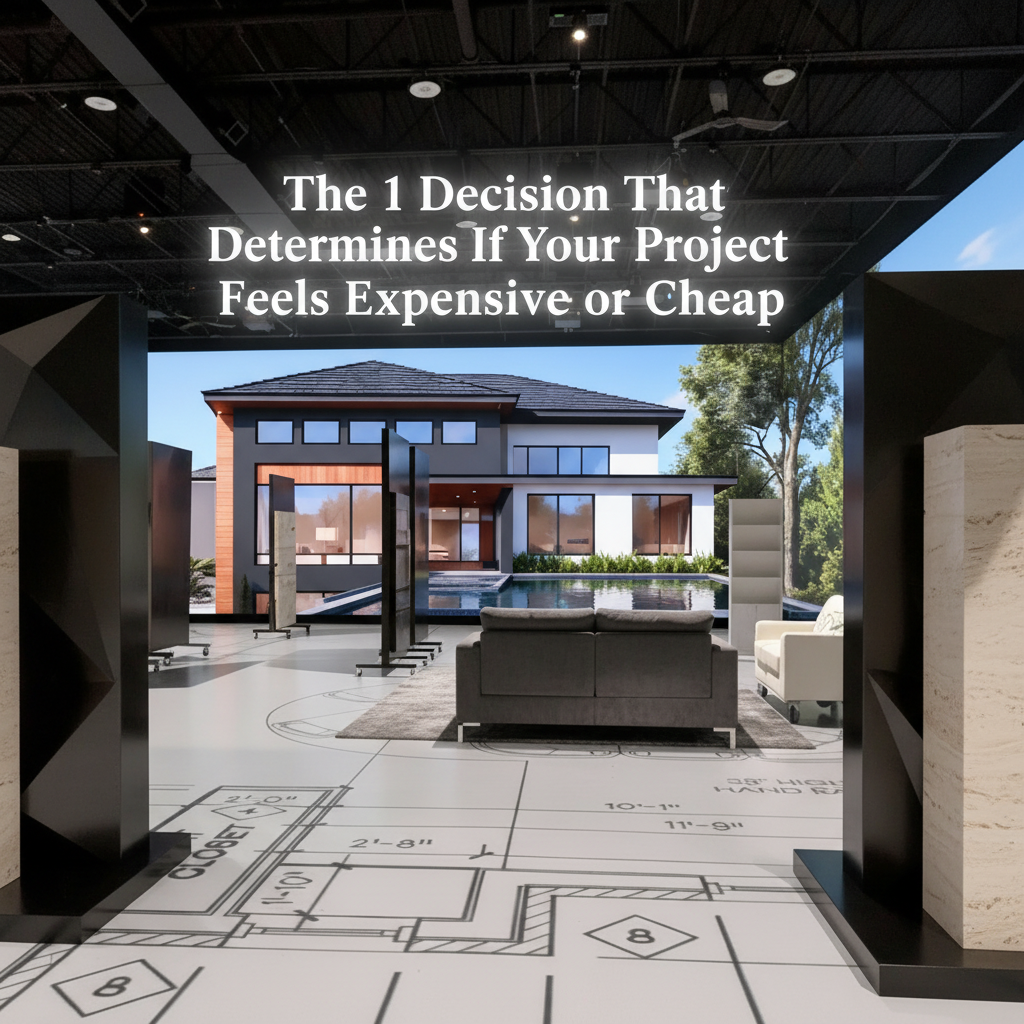
There’s a moment that separates average projects from truly exceptional ones—and it has nothing to do with how much money you spend.
It’s the moment you experience the space in motion.
You can invest in premium materials, high-end finishes, and custom details—but if the proportions, flow, and spatial transitions aren’t right, the entire project can still feel cheap. On the other hand, even a modest budget can feel luxurious when the space is designed with intention.
At The BluView, we’ve seen this time and time again: the most important decision is not what you add—it’s how the space feels when you move through it.
Why Expensive Materials Alone Don’t Create Luxury
Many clients assume that luxury architecture design is about marble slabs, imported finishes, or statement fixtures. While these elements help, they are not what truly defines a high-end space.
Luxury is perceived subconsciously.
It’s in:
- The way a hallway opens into a room
- The ceiling height relative to the space
- The alignment of doors, windows, and sightlines
- The balance between openness and privacy
If these elements are off, no material can fix the feeling. That’s why architectural proportions are the foundation of every premium project.
The Power of Proportion in High-End Design
Proportion is what your eye reads before your brain processes anything else.
When proportions are correct:
- Rooms feel balanced and calming
- Spaces feel larger without increasing square footage
- Light distributes naturally and evenly
- Transitions feel seamless and intentional
When proportions are wrong:
- Spaces feel cramped or awkward
- Ceilings feel too low or unnecessarily high
- Furniture never “fits right”
- The entire project feels disconnected
This is where building spatial experience becomes critical. It’s not about dimensions on paper—it’s about how those dimensions translate in real life.
Flow: The Invisible Luxury Feature
One of the most overlooked aspects of design is flow.
Flow is how effortlessly someone moves through a space without thinking.
In high-end projects:
- Movement feels intuitive
- Spaces reveal themselves gradually
- There is a sense of rhythm between areas
- Nothing feels forced or abrupt
In lower-quality designs:
- You feel stuck or unsure where to go
- Spaces feel disjointed
- Circulation paths interrupt functionality
- The experience feels chaotic
Great design doesn’t just look good—it guides you without you realizing it.
Walking the Space: The Ultimate Design Validation
Here’s the truth most people miss:
You cannot fully judge a design from drawings or renderings.
The real test is walking it.
This is where high end design validation happens.
When you physically move through a space (or simulate it correctly), you immediately feel:
- Whether proportions are right
- Whether transitions make sense
- Whether the space feels elevated or ordinary
At The BluView, we emphasize this step because it reveals what visuals cannot. A space that looks stunning on paper can feel completely different in reality.
The Emotional Impact of Spatial Experience
People don’t remember dimensions—they remember how a space made them feel.
A well-designed space can evoke:
- Comfort and calm
- Confidence and prestige
- Openness and freedom
- Warmth and connection
A poorly designed one can create:
- Subtle discomfort
- Visual noise
- Emotional detachment
- A sense that something is “off”
This emotional response is what separates standard projects from true luxury architecture design.
How to Make Your Project Feel Premium—Regardless of Budget
If you want your project to feel high-end, focus on these principles:
- Prioritize proportions before finishes
- Design the journey, not just the rooms
- Think in sequences, not isolated spaces
- Validate through experience, not just visuals
- Simplify where needed—clarity often feels more luxurious than complexity
Luxury is not about excess. It’s about precision.
The One Decision That Changes Everything
So what is the one decision?
It’s choosing to design for experience first, not appearance.
When you prioritize how a space feels—how it flows, how it opens, how it lives—you automatically elevate the entire project.
That’s what makes the difference between something that looks expensive… and something that truly feels it.