
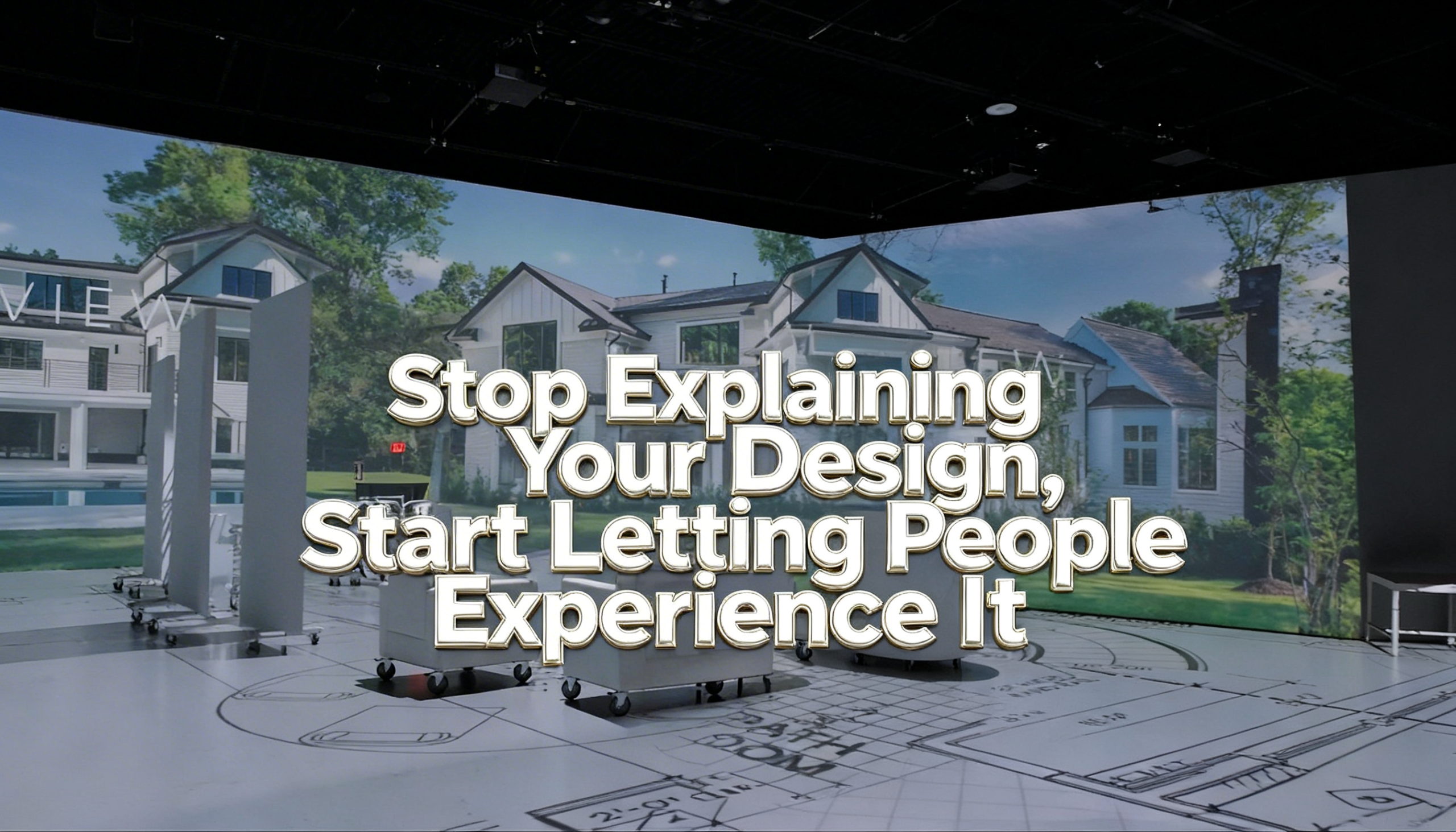
Every architect has been there.
You spend hours preparing a presentation.
You walk the client through the floor plan.
You explain the layout, the flow, the intent behind every decision.
You answer questions.
You send follow-up emails.
You revise.
You explain again.
And still… there’s hesitation.
Not because the design isn’t good.
But because the client doesn’t fully experience it yet.
This is the hidden challenge in architecture.
Design is often communicated through explanation — when it should be communicated through experience.
The Problem With Explaining Design
Architecture has traditionally relied on drawings, renderings, and verbal explanations.
Architects present.
Clients try to visualize.
Developers interpret.
But no matter how detailed the drawings are, they still require imagination.
And imagination creates gaps.
Clients may misunderstand proportions.
They may struggle to picture how rooms connect.
They may feel uncertain about spatial flow.
This is why so many projects require multiple meetings, revisions, and long email threads.
Even with the best architecture communication tools, there is still friction.
Because explaining a space is not the same as experiencing it.
Why Explanation Slows Everything Down
When a client doesn’t fully understand a design, the process slows down.
Decisions are delayed.
Questions multiply.
Revisions increase.
What should have been a clear “yes” becomes:
“Let me think about it.”
“Can we see another option?”
“I’m not sure how this will feel.”
This creates longer timelines, more work for architects, and more uncertainty for developers.
It also introduces risk.
Because decisions made without full clarity often lead to changes later — when they are more expensive.
This is why forward-thinking teams are shifting away from explanation… toward immersive architectural presentation.
From Explanation to Experience
Imagine a different kind of meeting.
Instead of sitting around a table reviewing drawings, the client walks into the design.
Walls surround them at full height.
Rooms appear at their real dimensions.
Hallways unfold exactly as they would in the final building.
There is no need to explain the layout.
They can see it.
They can walk it.
They can feel it.
This is the power of spatial visualization technology.
It transforms architecture from something abstract into something real.
And when something becomes real…
understanding becomes instant.
The End of Endless Meetings
One of the biggest advantages of immersive environments is the elimination of unnecessary meetings.
Instead of:
• multiple presentations
• long explanation calls
• back-and-forth emails
• repeated revisions
Teams can achieve clarity in a single session.
When clients experience the design, they don’t need as much explanation.
They ask better questions.
They make faster decisions.
They feel more confident.
This dramatically improves the architecture client experience.
And it saves time for everyone involved.
A Better Way to Communicate Architecture
Architecture is ultimately about human experience.
It’s about how people move through space, how they feel inside it, and how different elements come together to create an environment.
Trying to communicate that through drawings alone is limiting.
Immersive environments allow architects to communicate in the most natural way possible — through experience.
Instead of describing spatial flow, you walk it.
Instead of explaining proportions, you feel them.
Instead of imagining connections, you see them.
This is why immersive walkthroughs are becoming the most effective architecture communication tools available today.
Why Clients Respond Faster
When clients experience a design, something shifts.
They stop analyzing… and start feeling.
They don’t need to translate measurements into imagination.
They don’t need to guess how spaces will connect.
They understand it immediately.
This leads to:
• faster approvals
• fewer revisions
• stronger confidence in decisions
Because clarity removes hesitation.
And when hesitation disappears, projects move forward.
The Competitive Advantage in 2026
In today’s market, speed and clarity are critical.
Developers want faster timelines.
Clients expect better experiences.
Architects need more efficient workflows.
Those who rely solely on traditional methods may find themselves spending more time explaining and revising.
Those who adopt immersive experiences gain a clear advantage.
They communicate better.
They close decisions faster.
They deliver projects with greater confidence.
This shift is not just a trend.
It is becoming a new standard in architecture workflow innovation.
The Future Is Experiential
Architecture is evolving beyond drawings.
The future of design is not just about creating beautiful plans.
It’s about creating clear, shared understanding between everyone involved in a project.
And the most effective way to do that…
is to let people experience the design.
Because when people experience something, they don’t need convincing.
They already understand.
Experience Your Design Instead of Explaining It
At The BluView, architects, developers, and clients can step inside their projects through immersive full-scale walkthrough environments.
This allows teams to communicate designs clearly, reduce unnecessary meetings, and move forward with confidence.
Instead of spending time explaining your vision…
you can let people experience it.
And when they do, everything becomes simpler.
Visit The BluView
📍 The BluView Experience
156 Route 59, Suffern, NY 10901 – Unit B4
📞 Phone: (845) 533-4473 Ext. 101
📷 Instagram: @thebluview_experience
Experience your design before it becomes reality.