
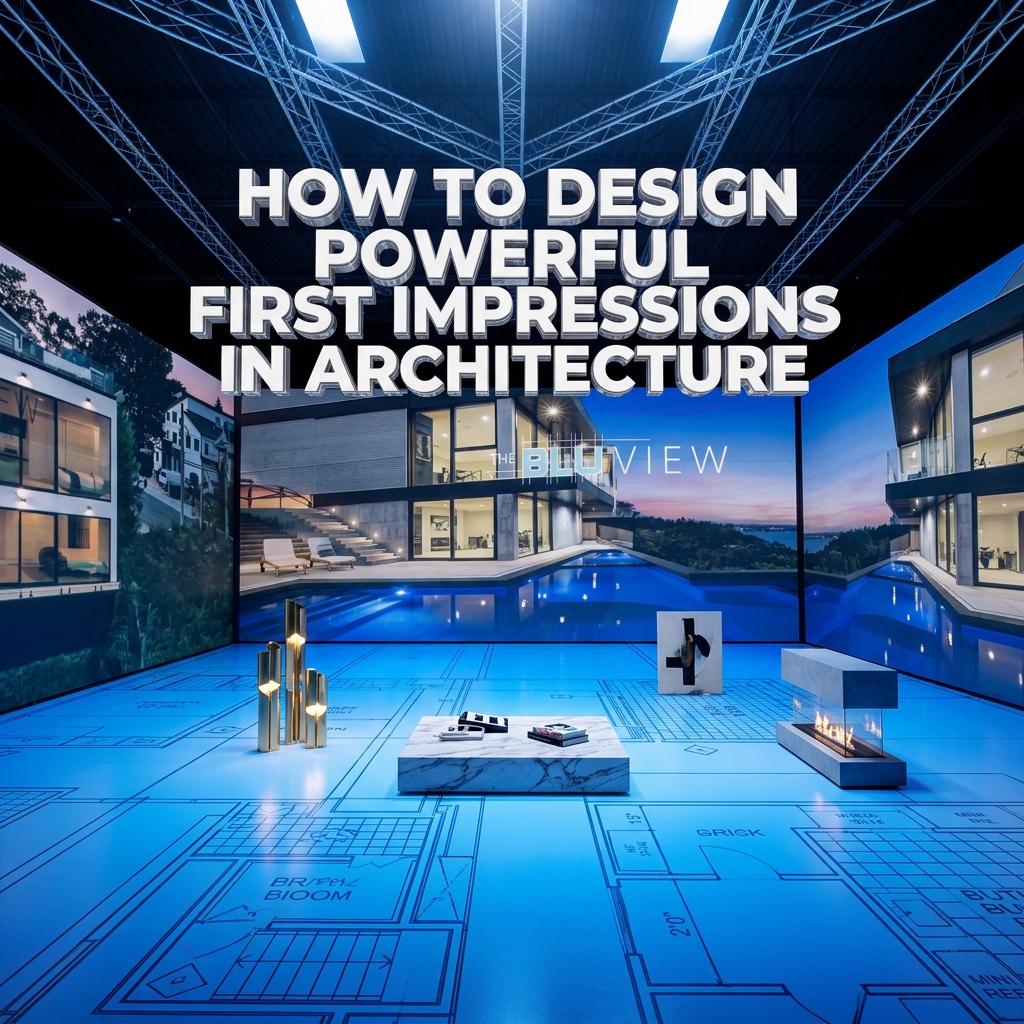
Before someone understands your space… they’ve already judged it.
Not logically. Not analytically.
But emotionally.
Within the first few seconds of entering, people instantly feel whether a space is:
- Open or restrictive
- Calm or chaotic
- Premium or average
And here’s the key:
That feeling happens before they even know why.
At The BluView, we design for that exact moment—because first impressions don’t just matter… they define the entire experience.
The Psychology Behind First Impressions in Design
Human perception is fast.
The brain processes spatial cues—light, scale, proportion, alignment—within seconds. Before someone notices finishes or details, they’ve already formed an emotional response.
This is where most projects succeed or fail.
Because no matter how well-designed a space is overall, if the entry experience is weak, the entire project feels underwhelming.
First impressions set the tone.
And that tone carries through everything that follows.
Why the Entry Sequence Matters More Than You Think
Design doesn’t begin in the living room or the kitchen.
It begins at the entry point.
The way someone enters a space determines:
- How the space is perceived
- How movement begins
- How the experience unfolds
A strong entry sequence creates:
- Anticipation
- Clarity
- Direction
A weak one creates:
- Confusion
- Disorientation
- A lack of impact
This is why entry design is one of the most critical—and most overlooked—elements in architecture.
The Power of the Visual Reveal
What you see first matters.
But more importantly, how the space reveals itself matters even more.
Great design doesn’t show everything at once.
It guides the eye.
It creates layers.
It builds a sense of discovery.
A powerful visual reveal:
- Frames key focal points
- Extends sightlines to create depth
- Introduces the space gradually
This creates a feeling of intentionality and sophistication.
On the other hand, when everything is immediately exposed without structure, the space can feel flat and underwhelming.
Designing Emotional Impact from the First Step
First impressions are emotional.
You don’t walk into a space and think, “The proportions are good.”
You feel:
- This is comfortable
- This feels open
- This feels high-end
Or the opposite.
This emotional reaction is driven by:
- Ceiling height relative to entry
- Light direction and intensity
- Alignment of openings
- Spatial compression and release
These elements work together to create an immediate impression—before logic ever kicks in.
Compression and Release: The Secret to Impact
One of the most powerful techniques in design is contrast.
Specifically, the contrast between compression and openness.
A slightly compressed entry followed by an open, expansive space creates:
- Dramatic impact
- A stronger sense of scale
- A more memorable experience
Without this contrast, even large spaces can feel flat.
This principle is widely used in high-end architecture because it enhances the first impression without adding cost—only intention.
Why Many Spaces Fail in the First 10 Seconds
Most designs focus on the main areas.
The living room. The kitchen. The finishes.
But they ignore the entry experience.
As a result:
- The space lacks a strong introduction
- Movement feels unclear from the start
- The emotional impact is weak
Even a high-end design can feel average if the first impression isn’t right.
Because people don’t remember the plan.
They remember how it felt when they walked in.
The Role of Flow in First Impressions
Flow begins immediately.
From the first step, the space should guide you naturally.
You should instinctively know:
- Where to go
- What to look at
- How to move
If there’s hesitation, the experience breaks.
Strong flow creates confidence.
And confidence is what makes a space feel premium.
How to Evaluate Your First Impression
Before approving any design, ask yourself:
What do I feel in the first 10 seconds?
Not what you see—what you feel.
Then look for:
- Is there a clear focal point?
- Does the space open up or feel restricted?
- Is movement intuitive or confusing?
- Does it feel intentional or accidental?
These answers will tell you everything.
The BluView Approach to First Impressions
At The BluView, we design the experience from the first step.
We focus on:
- Entry sequencing
- Visual alignment
- Spatial contrast
- Emotional impact
And most importantly, we validate it before construction.
Because first impressions are not something you fix later.
They are something you design intentionally from the start.
Why First Impressions Define the Entire Space
The first 10 seconds shape perception.
If the space feels premium immediately, everything that follows is elevated.
If it feels off, the entire experience is affected.
This is why first impressions are not a detail.
They are the foundation.
The Takeaway
People don’t need time to judge a space.
They feel it instantly.
So the question is:
What does your space say in the first 10 seconds?
Because that moment will define everything that comes after.