
Purim is a story about what isn’t obvious.
The miracle of Purim was not loud. It wasn’t dramatic in the way we usually imagine miracles. It unfolded quietly, through hidden turns of events, subtle decisions, and moments that only made sense in hindsight.
What appeared ordinary was extraordinary.
What seemed minor was monumental.
What was hidden shaped the outcome.
Design works the same way.
The biggest successes — and the most expensive mistakes — are often hidden in plain sight.
The Illusion of “It Looks Fine on Paper”
Architectural plans can appear flawless. Dimensions align. Code requirements are met. Rooms fit within the layout.
But design is not lived in lines and numbers.
It’s lived in movement.
In flow.
In how a space feels when you stand inside it.
A hallway that measures correctly can still feel tight.
A kitchen that fits on paper can disrupt daily circulation.
A living room that seems generous can shrink when furniture enters the space.
These issues are rarely dramatic on drawings. They are subtle. Quiet. Almost invisible.
Until construction begins.
The Hidden Mistakes That Cost the Most
In construction, the most expensive mistakes are not usually structural failures. They are proportion failures. Flow failures. Human experience failures.
• A door swing that interrupts circulation
• A sightline that blocks natural light
• A staircase landing that feels compressed
• A conference room that technically fits — but psychologically feels small
These are not obvious in 2D plans. They hide in plain sight.
And once built, they are permanent.
Purim and the Power of Revelation
Purim reminds us that what’s hidden can determine everything.
In the story, key moments happen quietly. A conversation here. A delayed decision there. A shift in perspective that changes the outcome.
In design, revelation works the same way.
When you step into your project at full scale — truly stand inside it — hidden details reveal themselves.
The space speaks.
Suddenly:
You notice the ceiling height differently.
You feel the distance between rooms.
You sense whether circulation supports or fights your lifestyle.
What was abstract becomes undeniable.
Paper Hides. Space Reveals.
2D drawings are powerful tools — but they require imagination. And imagination varies.
Each stakeholder sees something slightly different in their mind. Architects visualize proportions. Builders interpret constructability. Clients imagine lifestyle.
But imagination is not alignment.
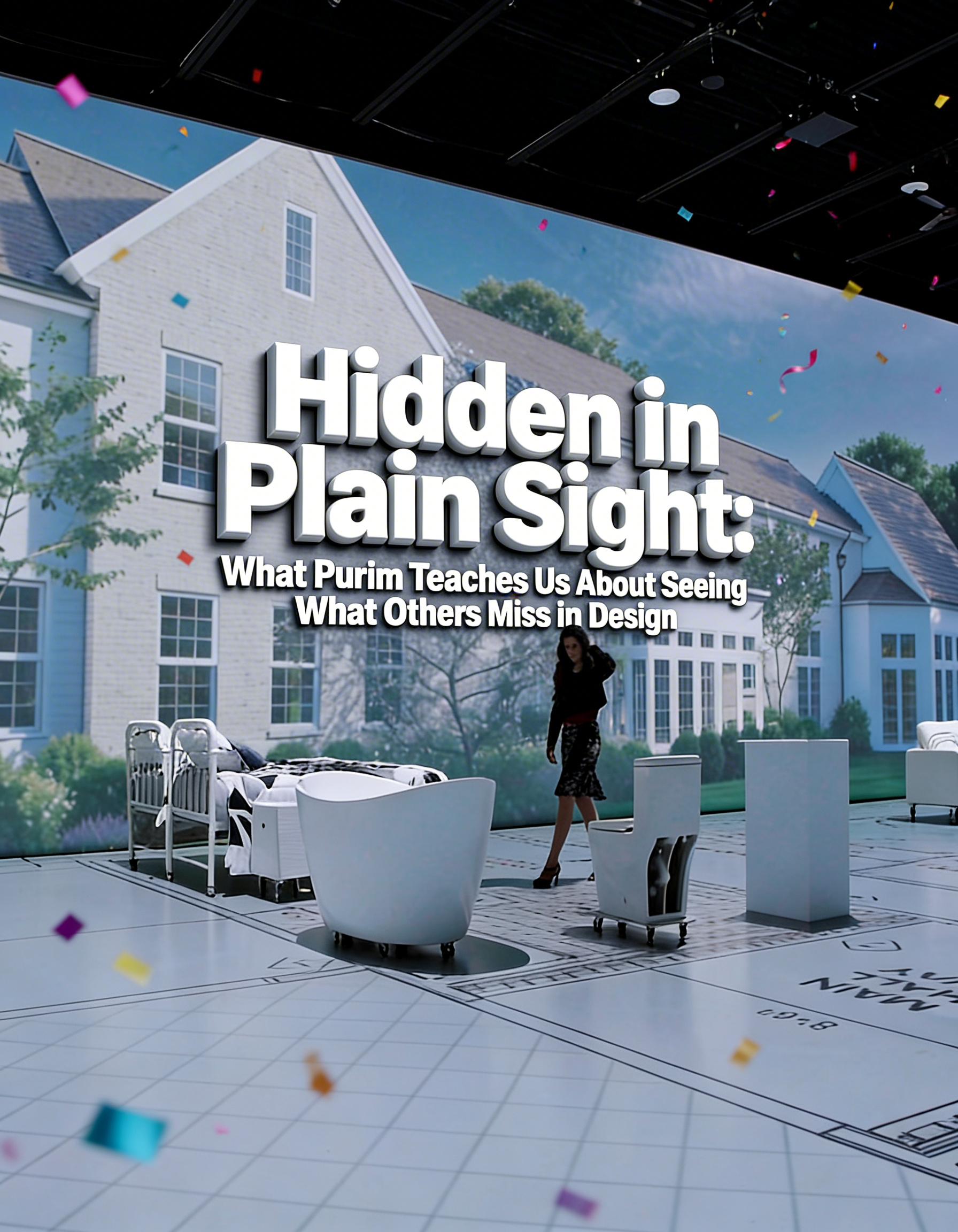
At The BluView Experience, we remove interpretation.
When a project is walked at 1:1 scale, proportion becomes physical. Circulation becomes real. Sightlines become visible. Assumptions disappear.
Paper hides. Space reveals.
Proportions You Can Feel
Proportion is one of the most misunderstood aspects of design.
A 12-foot room on paper can feel expansive — or tight — depending on ceiling height, openings, and adjacency.
Numbers don’t communicate feeling.
Walking the room does.
BluView allows homeowners, architects, and developers to physically test space before it exists. They feel distances. They move naturally through pathways. They discover what works — and what doesn’t — before anything is built.
Circulation Is Invisible Until You Walk It
Circulation is rarely the first thing clients think about. But it’s what determines daily comfort.
Morning routines. Guest flow. Entertaining. Privacy. Noise. Accessibility.
On drawings, circulation is a line between rooms.
In real life, it’s the difference between harmony and frustration.
Walking the project reveals bottlenecks, awkward turns, and hidden inefficiencies that 2D plans simply cannot expose.
Sightlines Shape Experience
What do you see when you enter the home?
What do guests see first?
Where does natural light travel?
What becomes the focal point?
Sightlines define emotional impact. Yet they are almost impossible to fully understand from elevations alone.
Full-scale walkthroughs allow teams to experience sightlines naturally — to see the reveal of a living space, the alignment of a feature wall, the openness of a lobby.
It transforms design from theoretical to experiential.
The Cost of Overlooking the Subtle
Hidden design flaws are rarely dramatic at first. But over time, they create dissatisfaction.
Clients may not articulate it as a design issue — but they feel it. A space feels slightly off. A room feels awkward. A layout feels inefficient.
Those feelings often begin in subtle details that were missed before construction.
Purim teaches that subtle moments can shape outcomes.
BluView ensures those subtle moments are revealed early — when change is still easy.
Designing With Awareness, Not Assumption
Great design requires awareness.
Awareness of scale.
Awareness of human behavior.
Awareness of how space influences daily life.
By walking plans before building them, teams move from assumption to certainty. From imagination to clarity.
And that shift changes everything.
Seeing What Others Miss
The difference between a good project and a great one often lies in what most people overlook.
At The BluView Experience, we help clients see what others miss — before it becomes concrete.
We reveal hidden proportions.
We expose subtle circulation issues.
We clarify sightlines.
We strengthen alignment.
Because the most powerful design decisions are made when the hidden becomes visible.
This Purim, remember:
What’s hidden matters.
Walk it. Reveal it. Build it right.