
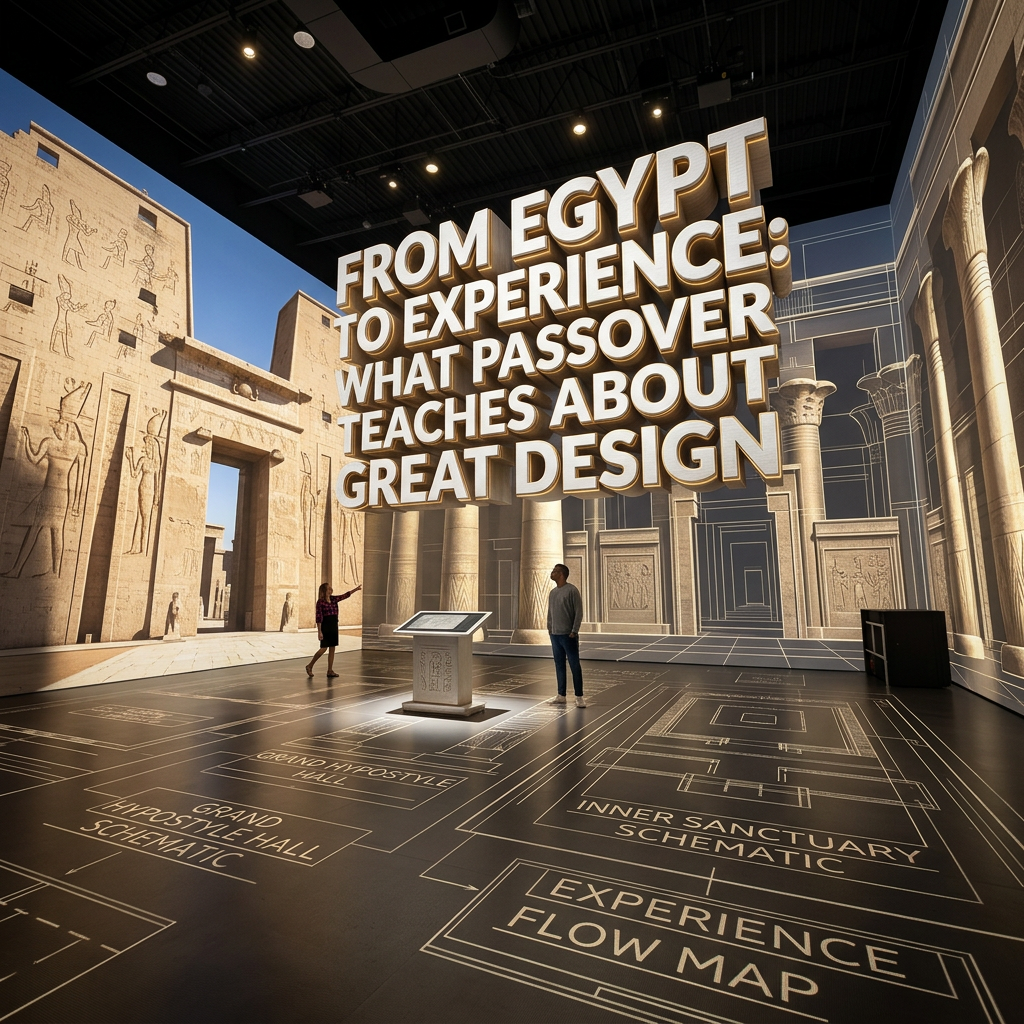
Passover is a story of movement.
Not just movement from one place to another—but a transformation. A journey from restriction to freedom, from limitation to expansion.
And while it’s a deeply meaningful historical and spiritual story, it also reveals something surprisingly relevant to architecture:
Great design is not a layout—it’s a journey.
At The BluView, we approach every project with this mindset. Because the most powerful spaces aren’t just seen… they are experienced over time.
The Journey Is the Design
Most people think of design as a final result.
A finished layout. A completed structure. A visual outcome.
But in reality, design is experienced in sequence.
You don’t absorb a space all at once—you move through it.
Step by step. Transition by transition.
Just like the Passover journey, where every stage has meaning, every shift in a space contributes to how it’s perceived.
That’s what defines a true spatial experience.
Why Layout Alone Is Not Enough
A layout is static.
It shows placement—but not progression.
You can have a perfectly organized plan that still feels flat, disconnected, or uninspiring.
Because what’s missing is the journey.
Great architecture considers:
- How a space is entered
- How it unfolds
- How it transitions
- How it concludes
Without this, even the most visually appealing design lacks depth.
The Power of Sequence in Architecture
Sequence is what gives a space meaning.
It’s the order in which you experience things—and how each moment leads to the next.
In high-end design:
- Entry creates anticipation
- Transition builds tension
- Open areas provide release
- Private zones create intimacy
This rhythm is what transforms a structure into an experience.
It’s what separates ordinary layouts from immersive architectural environments.
From Constraint to Flow
The Passover story is about leaving constraints behind.
And in design, constraints are often hidden.
Not walls—but poor transitions.
Not size—but disconnected sequencing.
Not structure—but lack of flow.
When a space is designed without considering movement, it creates friction.
You feel it in:
- Awkward transitions
- Disjointed areas
- Lack of continuity
But when flow is intentional, everything changes.
The space feels:
- Effortless
- Open
- Aligned
That’s what real freedom in design looks like.
Designing Transitions That Tell a Story
Transitions are where the journey happens.
They are often overlooked—but they are the most powerful part of any design.
A well-crafted transition:
- Guides movement naturally
- Creates emotional shifts
- Adds depth to the experience
Instead of abrupt changes, great spaces evolve gradually.
You move from one feeling to another—without resistance.
This is where architectural storytelling comes to life.
Emotional Design: The Missing Layer
People don’t just interact with spaces physically—they respond emotionally.
A well-sequenced space can evoke:
- Calm
- Excitement
- Comfort
- Clarity
A poorly sequenced one can create:
- Confusion
- Discomfort
- Disconnection
This emotional layer is what defines high-end design.
It’s not just about how a space functions—but how it feels throughout the journey.
Why Experience Must Come Before Construction
Most projects are approved based on visuals.
Plans. Renderings. Static representations.
But these don’t capture sequence or movement.
They don’t show how a space unfolds over time.
That’s why many projects look incredible on paper—but feel underwhelming in reality.
To truly evaluate a design, you need to experience it.
This is where immersive walkthroughs become essential.
Walking the Journey Before It Exists
When you walk through a space before it’s built, you understand it instantly.
You can feel:
- Whether transitions make sense
- Whether the sequence flows naturally
- Whether the experience is cohesive
This is how you move from assumption to certainty.
And it’s one of the most important steps in creating a successful project.
The BluView Approach to Experiential Design
At The BluView, we don’t design spaces—we design journeys.
We help clients:
- Visualize and experience their space before construction
- Identify breakdowns in flow and sequence
- Refine transitions and spatial relationships
- Ensure every step of the experience feels intentional
Because the goal is not just to create something impressive.
It’s to create something that feels right—from beginning to end.
Great Design Is a Journey
Just like Passover is not defined by a single moment, great design is not defined by a single space.
It’s defined by the journey between spaces.
The sequence. The transitions. The experience.
When those elements are aligned, the result is more than a well-designed project.
It’s a space that tells a story.
The Takeaway
If you want your project to feel elevated, don’t just focus on the layout.
Focus on the journey.
Because in the end, people won’t remember the plan.
They’ll remember how it felt to move through it.