
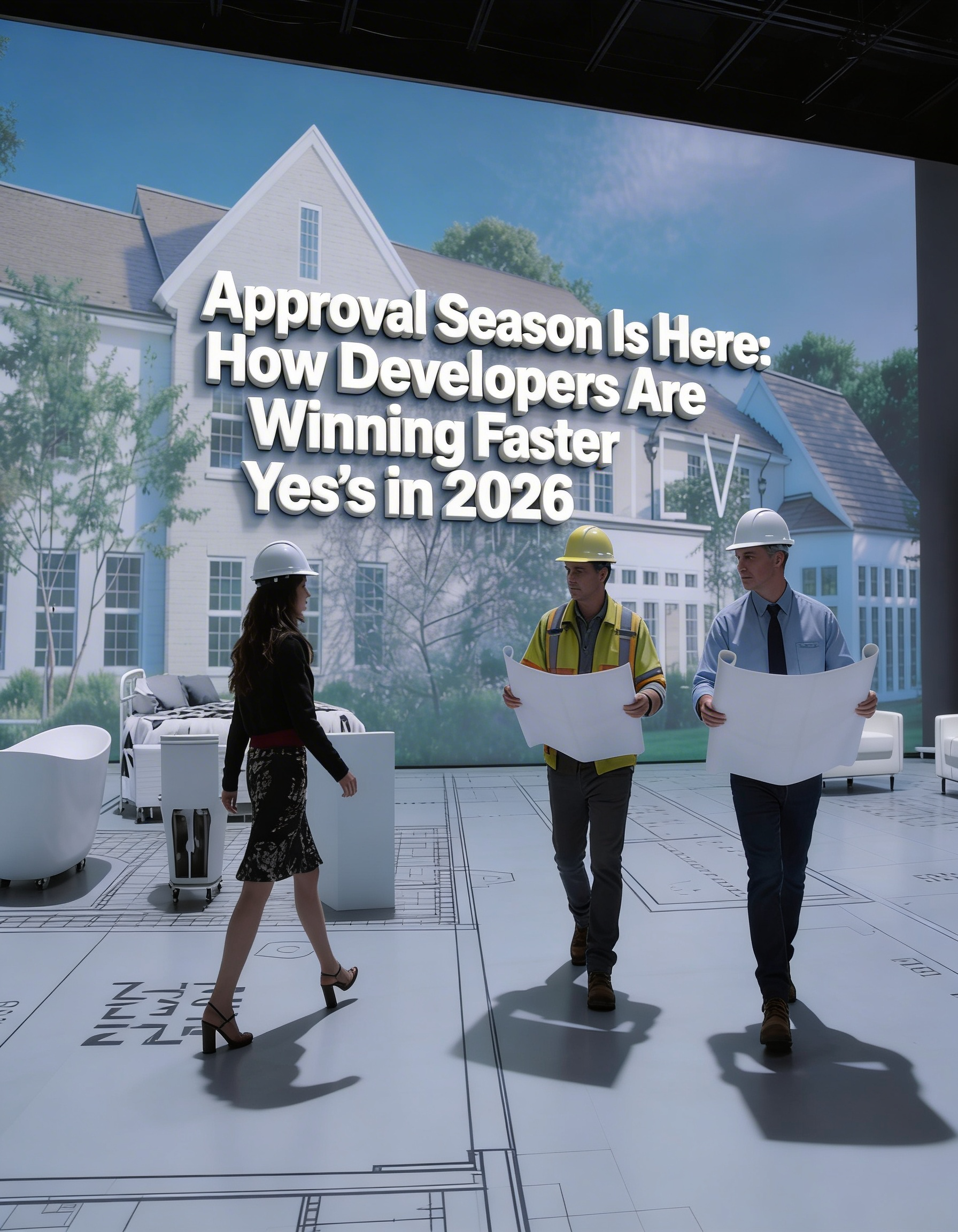
Every year, there’s a window.
A season when municipal calendars fill up. When planning board approvals, zoning hearings, and site plan reviews accelerate. When developers either gain momentum — or lose months.
That season is here.
And in 2026, the developers who are winning faster “yes” decisions aren’t just presenting better drawings.
They’re presenting better clarity.
At The BluView Experience, we’re seeing a clear trend: projects that are physically validated before submission move through approval processes with stronger confidence and fewer delays.
The Reality of 2026 Municipal Approvals
Planning boards are under pressure.
Communities are growing. Regulations are tightening. Public scrutiny is increasing. Board members are more cautious than ever — especially in high-density markets like New York and New Jersey development zones.
What does that mean?
Approvals aren’t just technical anymore.
They’re experiential.
Boards are evaluating:
• Building massing and scale perception
• Pedestrian circulation and access
• Traffic flow impact
• Streetscape integration
• Community fit and visual presence
And here’s the problem:
Most of these factors are hard to fully understand from 2D architectural plans alone.
Why Good Projects Still Get Delayed
Developers often enter hearings confident. The drawings are compliant. The engineering is solid. The consultants are aligned.
Yet hearings stall.
Why?
Because uncertainty enters the room.
If a board member struggles to visualize height proportions…
If massing feels unclear…
If circulation raises questions…
Even a strong project can be deferred for revisions.
That’s how planning board delays happen — not from fatal flaws, but from incomplete clarity.
The Shift: From Presentation to Pre-Validation
The most strategic developers in 2026 are shifting their approach.
Instead of preparing to defend a design during a hearing, they are validating it before submission.
They’re asking:
• Does the scale feel appropriate?
• Does the entry communicate openness?
• Does circulation align with real-world behavior?
• Are sightlines working as intended?
Full-scale walkthrough validation provides answers before the board ever sees the project.
Full-Scale Walkthroughs Strengthen Approval Confidence
At The BluView Experience, developers and architects walk their projects at true 1:1 scale.
They experience:
• Lobby proportions
• Corridor widths
• Entry impact
• Spatial transitions
• Human-scale massing perception
This is not virtual rendering.
It’s life-size architectural projection.
When teams experience their project physically, blind spots surface early. Small refinements can be made before submission.
That preparation reduces objections.
And fewer objections mean faster approvals.
Planning Board Psychology in 2026
Municipal boards are not just reviewing documents. They are assessing risk.
They want to know:
• Has the development team thoroughly evaluated impact?
• Is the project aligned internally?
• Does the team appear confident and cohesive?
When architects and developers walk into hearings having physically tested their design, their answers are sharper. Their body language reflects certainty. Their explanations are grounded in experience.
That confidence is persuasive.
Confidence accelerates decision-making.
Preventing the Cost of Deferrals
A single deferral can cost more than most teams realize.
It impacts:
• Financing timelines
• Investor confidence
• Contractor scheduling
• Marketing momentum
• Community relations
In competitive markets, momentum is leverage.
Developers who secure first-round approvals retain that leverage.
Full-scale pre-approval validation is becoming a competitive advantage — especially for multi-unit residential, mixed-use developments, and commercial projects seeking zoning approval in 2026.
Why This Strategy Is Trending
Three major forces are driving this shift:
- Rising construction costs – There is less room for error.
- Stricter municipal oversight – Boards are cautious.
- Competitive development markets – Timing is everything.
Developers cannot afford reactive approval strategies.
They need proactive validation.
From Uncertainty to Assurance
Approval season doesn’t reward the loudest presentation.
It rewards the clearest project.
Walking the project before the hearing allows teams to:
• Anticipate objections
• Refine messaging
• Strengthen alignment
• Improve design perception
• Reduce revision cycles
This isn’t about changing the project entirely.
It’s about strengthening it strategically.
The Smartest Developers Walk First
In 2026, the winning formula for faster planning board approvals is simple:
Experience before exposure.
When your project has been physically validated at full scale, you don’t rely on imagination.
You rely on certainty.
And certainty moves boards toward “yes.”