
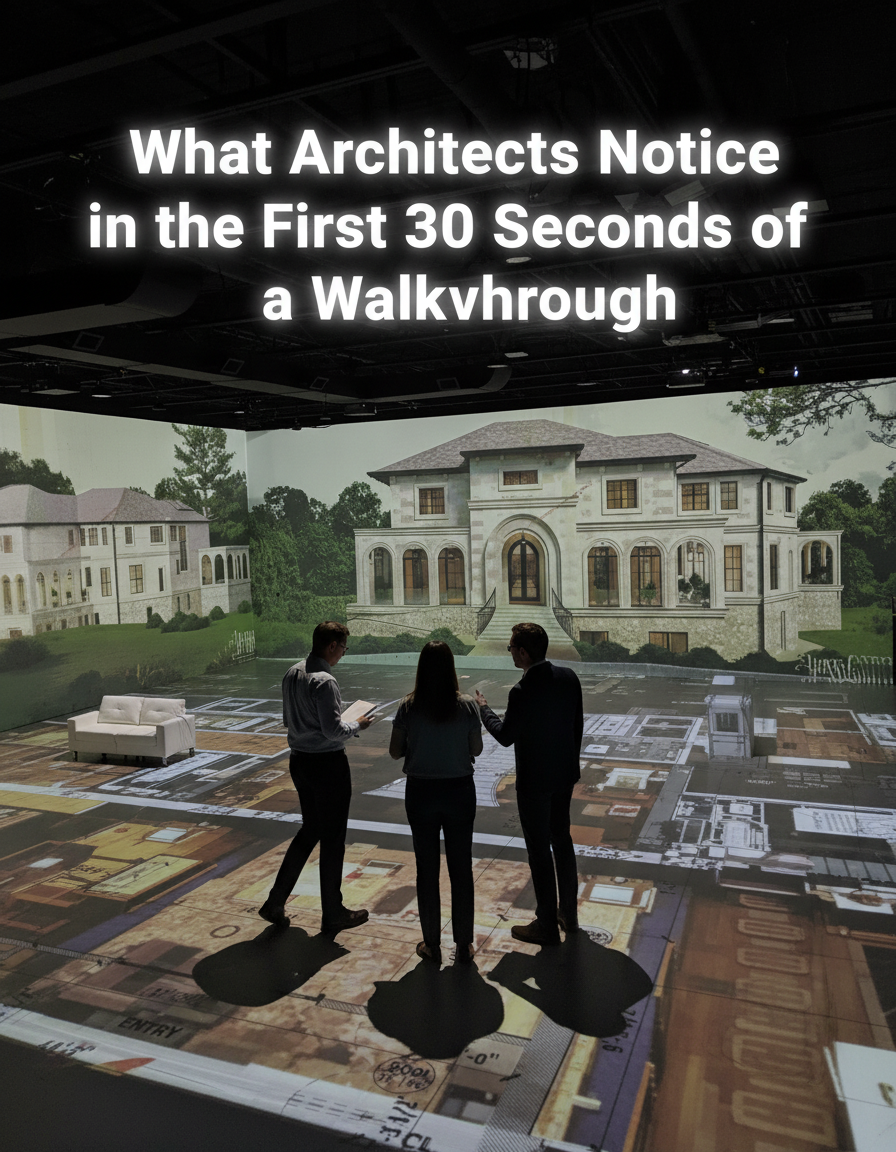
When an architect steps into a space for the first time, something interesting happens.
Before a single conversation begins… before measurements are discussed… before design explanations are given… the architect’s mind begins analyzing the environment instantly.
Within the first 30 seconds, trained eyes and spatial intuition begin evaluating proportions, circulation, sightlines, and the overall architectural flow of the space.
This moment is subtle, but it is incredibly powerful.
Because architecture is not just about how a building looks. It is about how it feels when people move through it.
And the fastest way to understand that is through experience, not drawings.
This is why full-scale walkthrough environments are becoming one of the most important tools in modern architecture.
The Brain of an Architect Never Stops Observing
Architects spend years developing the ability to read spaces quickly.
Just like a musician hears subtle differences in sound or a chef tastes the balance of flavors instantly, architects are trained to sense spatial relationships almost immediately.
When they step into a design environment, they instinctively begin analyzing:
• spatial proportions
• circulation patterns
• sightlines and visual connections
• room relationships
• the flow between spaces
These evaluations often happen in seconds, because spatial perception is deeply connected to movement and perspective.
This is what makes architectural spatial experience so valuable.
You can analyze drawings for hours, but walking through a design can reveal insights almost instantly.
The First Thing Architects Notice: Proportions
One of the first things architects evaluate is proportion.
Proportion refers to the relationship between the size of rooms, ceiling heights, and the distances between architectural elements.
On a floor plan, proportions may appear balanced and logical. But once experienced at full scale, those relationships can feel very different.
For example:
A living room may look spacious on paper but feel compressed when experienced physically.
A hallway may technically meet code requirements but feel uncomfortable when walking through it.
These subtle differences are often invisible in drawings.
But they become obvious during immersive architecture testing.
The Second Observation: Circulation Flow
After evaluating proportions, architects naturally begin observing circulation.
Circulation refers to how people move through a space.
Is the path between rooms clear and intuitive?
Do doorways interrupt the natural flow?
Does movement through the space feel smooth or awkward?
Good architecture guides people effortlessly from one area to another. Poor circulation creates confusion or congestion.
When architects step into a full-scale walkthrough environment, they instinctively test this flow.
They walk from the entry toward the main living space. They observe how rooms connect. They examine how easily people can move between functions.
This immediate architecture walkthrough analysis helps reveal whether the layout truly works.
The Third Insight: Sightlines
Sightlines are another critical element architects notice almost instantly.
Sightlines determine what people see when they enter a space or move from one room to another.
For example:
What is the first thing someone sees when they walk through the front door?
Does the design frame an important view?
Do walls block visual openness?
Great architecture uses sightlines to create moments of discovery and connection.
A properly framed view can make a room feel larger, brighter, and more inviting.
When architects step into a walkthrough environment, they quickly evaluate these visual connections.
They look toward windows, across rooms, and down hallways to see how the building reveals itself through movement.
The Fourth Element: Spatial Comfort
Finally, architects evaluate something that is difficult to describe in drawings but obvious in real life.
Spatial comfort.
This refers to how natural and comfortable a space feels when someone stands inside it.
Does the room feel open and welcoming?
Does the ceiling height match the function of the space?
Do the proportions feel balanced?
These qualities are subtle, but they play a huge role in how people experience architecture.
And they can only be fully understood through immersive architectural environments.
Why These First 30 Seconds Matter
Those first moments of spatial experience are not just instinctive reactions.
They are valuable design validation techniques.
If something feels off within the first 30 seconds, it usually means the layout needs adjustment.
The beauty of discovering this early is that changes can be made easily before construction begins.
A wall might move a few inches. A doorway may shift slightly. A hallway might widen just enough to improve comfort.
These small refinements can dramatically improve the final building.
And they are much easier to make before materials are ordered and walls are framed.
From Drawings to Real Spatial Experience
Architecture has traditionally relied on drawings, renderings, and models to communicate design intent.
While these tools remain essential, they do not fully replicate how people experience space in real life.
Full-scale walkthrough environments bridge this gap.
They allow architects, developers, and clients to experience the design at its true size.
Walls appear at their real height. Rooms extend to their actual dimensions. Circulation paths unfold exactly as they would in the completed building.
This transformation turns design review into immersive architecture testing.
Instead of imagining the space, teams can walk through it.
And within the first 30 seconds, architects can begin identifying insights that may improve the project.
A Better Way to Align Architects, Developers, and Clients
Another advantage of spatial walkthroughs is how quickly they align everyone involved in the project.
Architects may understand the design deeply, but clients and developers often struggle to visualize drawings.
When everyone experiences the project together, communication becomes much easier.
Clients see exactly how the rooms connect. Developers understand the scale of the project. Architects can explain design decisions while standing inside the space.
This shared experience dramatically improves collaboration and speeds up decision-making.
Instead of long meetings reviewing drawings, teams can make confident choices in real time.
The Future of Architecture Is Experiential
Architecture is evolving.
New technologies and immersive design environments are changing how buildings are planned, tested, and refined.
Experiencing a design before construction begins is quickly becoming one of the most valuable steps in the architectural process.
It allows architects to test spatial relationships, improve layouts, and strengthen collaboration with clients.
Most importantly, it helps ensure that the final building performs exactly as intended.
Because the best way to understand architecture…
is to walk through it.
Experience Your Design Before Construction Begins
At The BluView, architects, developers, and builders can step inside their projects through full-scale immersive walkthrough environments.
Using advanced spatial visualization technology, teams can evaluate proportions, circulation, sightlines, and spatial comfort before construction begins.
Instead of relying on imagination alone, they can experience the building at life-size scale.
This approach helps prevent costly design mistakes, improves communication between teams, and ensures that projects move forward with confidence.
Visit The BluView
📍 The BluView Experience
156 Route 59, Suffern, NY 10901 – Unit B4
📞 Phone: (845) 533-4473 Ext. 101
📷 Instagram: @thebluview_experience
Schedule your walkthrough and experience your design before it becomes reality.