
Every architect remembers the early years of training.
Long studio nights. Endless sketches. Physical models built from foam board and cardboard. Floor plans carefully drafted to perfection. Renderings that transformed ideas into beautiful visual stories.
Architecture school teaches designers how to think, analyze, and create space. Students learn about proportion, structure, materiality, lighting, and form. They study how buildings interact with their surroundings and how design can shape the human experience.
But there is one critical step in the architectural process that most schools never teach.
It is not about drawing.
It is not about rendering.
It is about experiencing the space before it exists.
And today, that step is becoming one of the most valuable tools in modern architecture.
The Traditional Architecture Workflow
For decades, the architectural workflow has followed a familiar pattern.
First comes the concept. Architects sketch ideas and explore possibilities through diagrams and massing studies. These ideas evolve into floor plans, sections, and elevations that define the structure and organization of the building.
Next come digital models and renderings. Advanced visualization software helps architects present their designs to clients with impressive realism. Materials, lighting, and textures bring the concept to life on screen.
Then the project moves toward approvals, documentation, and construction.
At this stage, the building transitions from drawings to reality.
Only once construction begins do teams truly see how the design functions in physical space.
This process has shaped architecture for generations.
But it also leaves a critical gap between design intention and spatial experience.
The Problem With Drawings Alone
Architectural drawings are powerful communication tools, but they are still representations of space rather than the space itself.
A floor plan can describe dimensions. A rendering can illustrate aesthetics. A model can show overall form.
But none of these tools can fully replicate what happens when a person physically walks through a room.
Human spatial perception depends on movement, perspective, and scale. The way a hallway feels when walking through it cannot be completely predicted from a drawing. The relationship between rooms becomes clearer when experienced from within the space.
Architects are trained to mentally visualize these experiences, but even the most experienced professionals sometimes discover spatial insights only after construction begins.
That is why a new step is emerging in the architectural workflow.
The Missing Step: Experiencing the Space Before It Exists
Imagine being able to walk through a building before construction begins.
To stand in the living room and see how the kitchen connects. To walk down the hallway and feel the proportions. To experience the view from the entry before the foundation is even poured.
This is the new step transforming architectural design.
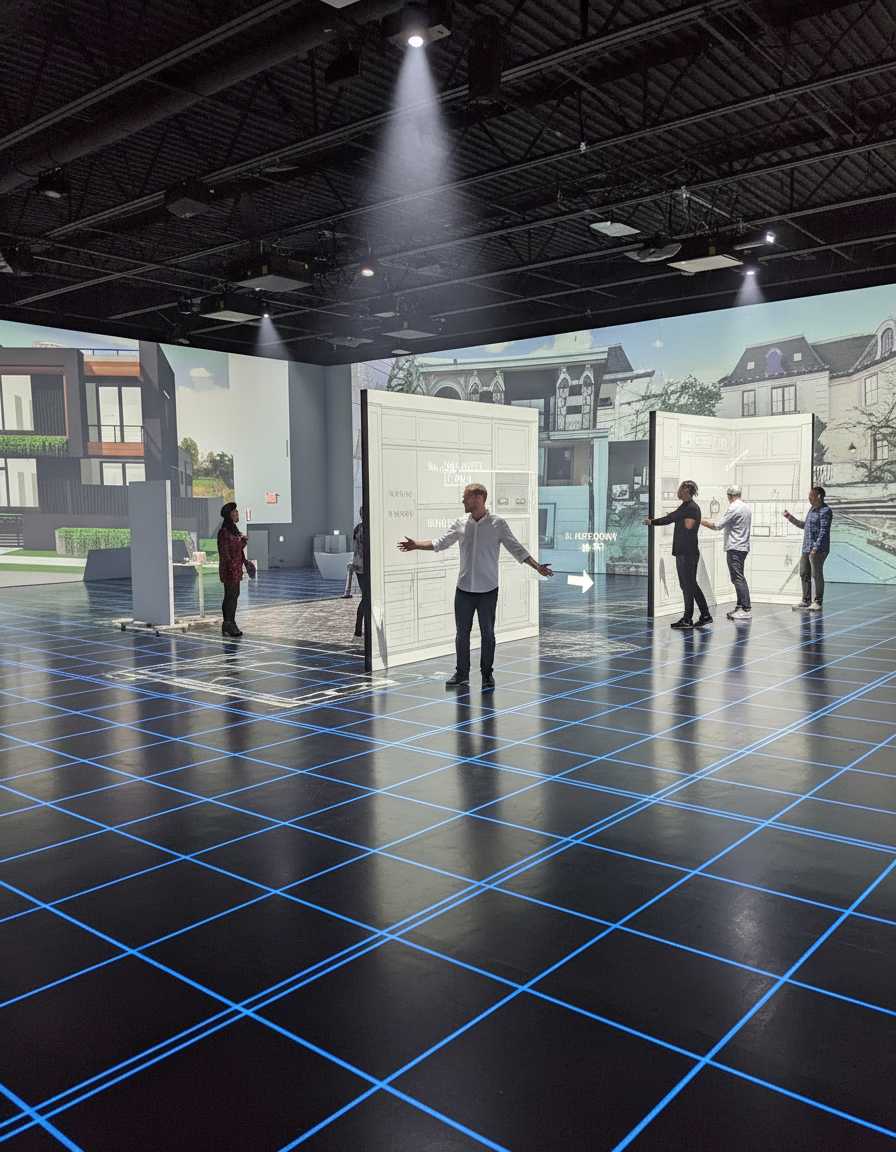
Instead of relying solely on drawings and renderings, architects can now validate their projects through full-scale architectural walkthrough environments and immersive spatial visualization technology.
This process allows architects, developers, and clients to physically experience the design at true scale.
Walls appear at full height. Rooms extend to their exact dimensions. Circulation paths unfold exactly as they will in the finished building.
The design becomes something that can be walked through, explored, and refined.
Why Experiencing a Design Changes Everything
The moment architects step inside a full-scale representation of their design, they begin noticing things that drawings could never fully reveal.
They see how natural the movement between spaces feels. They notice whether a hallway feels comfortable or narrow. They evaluate sightlines and visual connections between rooms.
Sometimes they confirm that the design works perfectly.
Other times they make small adjustments that dramatically improve the spatial experience.
These adjustments might include shifting a wall slightly, widening an opening, or adjusting the relationship between rooms.
While these changes may seem minor, discovering them before construction begins can prevent costly revisions later in the project.
This is why immersive architectural walkthroughs are becoming an essential part of modern design validation and construction risk reduction.
A Better Way to Collaborate With Clients
Another major advantage of experiencing a design is how it improves communication with clients.
Architects spend months studying drawings and models, so they often understand the project deeply. Clients, however, may struggle to interpret technical plans and visualize the final space.
When clients step inside a full-scale walkthrough environment, their understanding changes immediately.
Instead of trying to imagine the space, they can simply walk through it.
They see how the rooms connect. They feel the proportions of the layout. They experience the spatial flow exactly as it will exist in the completed building.
This clarity transforms the conversation between architects and clients.
Questions are answered faster. Decisions are made more confidently. The entire design process becomes more collaborative and transparent.
The Future of Architectural Design
Architecture has always been about creating environments that shape human experience. Yet until recently, architects had limited ways to evaluate that experience before construction.
New immersive visualization technologies are now redefining the design process.
Architects can test their ideas in real space, validate spatial relationships, and refine layouts long before construction begins.
This approach bridges the gap between imagination and reality.
It also helps reduce construction risks, improve design clarity, and ensure that buildings perform exactly as intended.
In many ways, this step represents the next evolution of architectural design.
It complements traditional drawings, models, and renderings by adding something they cannot provide: real spatial experience.
The Lesson Architecture Schools Never Taught
Architecture schools teach creativity, technical skill, and design thinking. These foundations are essential for every architect.
But the modern design process is evolving.
Today’s architects have access to tools that allow them to test their designs in ways that previous generations could only imagine.
Experiencing the space before construction begins is quickly becoming one of the most powerful additions to the architectural workflow.
It allows architects to design with greater confidence, collaborate more effectively with clients, and deliver projects that perform exactly as intended.
In other words, the future of architecture is not only about designing buildings.
It is about experiencing them before they are built.
Experience Your Design Before Construction Begins
At The BluView, architects, developers, and builders can step inside their projects through full-scale immersive architectural walkthrough environments.
Using advanced projection technology and life-size spatial simulation, project teams can explore their designs exactly as they will feel when completed.
This process helps teams validate layouts, refine design decisions, and align with clients before construction begins.
Instead of imagining the space through drawings alone, you can experience it in real life.
Because the most powerful step in architecture may be the one nobody taught in school.
Visit The BluView
📍 The BluView Experience
156 Route 59, Suffern, NY 10901 – Unit B4
📞 Phone: (845) 533-4473 Ext. 101
📷 Instagram: @thebluview_experience
Schedule a walkthrough and experience your design before it becomes reality.