
Construction projects have always followed a familiar sequence. A developer secures the land, architects prepare the drawings, approvals are obtained, and the building process begins. For decades, this workflow has defined how projects move from concept to reality.
But in 2026, something new is quietly reshaping that process.
Forward-thinking developers are adding one powerful step before construction begins — experiencing the building at full scale.
This step is changing how projects are approved, how designs are validated, and how teams collaborate before construction starts. In an industry where mistakes can cost thousands or even millions, developers are realizing that validating a project through immersive architectural walkthrough environments can dramatically reduce risk and improve confidence.
Today, the smartest developers are no longer asking, “Does the drawing look good?”
They are asking a different question.
“Does the space actually work when you walk through it?”
Why Pre-Construction Decisions Matter More Than Ever
The pre-construction phase is where the most critical decisions are made. Layouts are finalized, budgets are confirmed, and construction schedules are established. Once a project moves beyond this phase, making changes becomes increasingly difficult.
Walls are framed. Structural elements are installed. Mechanical systems are coordinated between multiple trades.
At that stage, even small design adjustments can trigger expensive change orders and construction delays.
This is why pre construction planning innovation has become such an important focus for developers.
Instead of discovering design issues during construction, modern development teams are identifying and solving them earlier in the process. The goal is simple: eliminate uncertainty before building begins.
The Limitations of Traditional Design Review
Architects rely on drawings, renderings, and digital models to communicate their designs. These tools have evolved dramatically in recent years and are essential to the design process.
However, they still share one limitation.
They require people to imagine the space.
A floor plan shows measurements and room relationships. A rendering illustrates materials and lighting. But neither fully replicates how a building will feel when someone moves through it.
Human perception of space depends on movement, perspective, and physical scale. These qualities are difficult to evaluate on a screen.
As a result, many architectural planning errors and building layout problems only become obvious once construction begins.
This is where immersive architectural visualization technology is transforming the industry.
Experiencing the Building Before It Exists
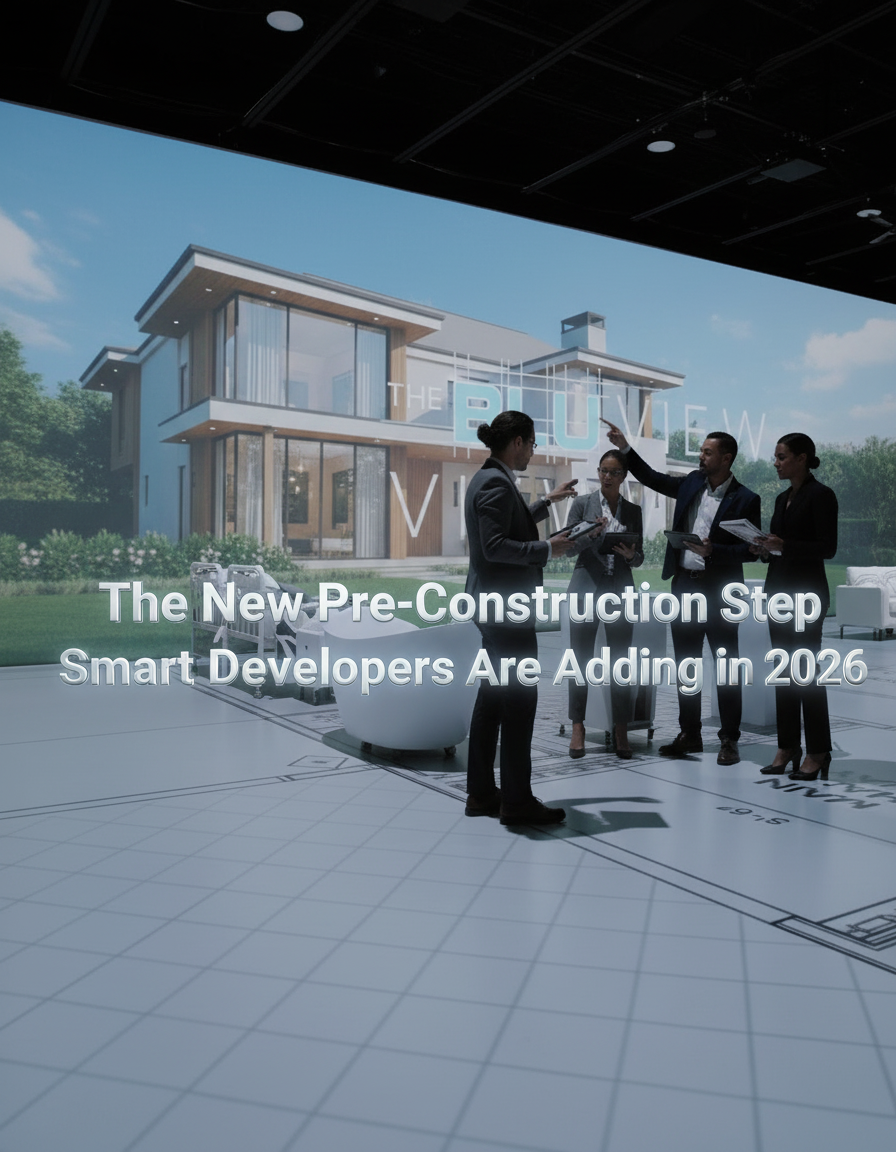
Full-scale architectural walkthrough environments allow architects, developers, and clients to step inside their projects before construction begins.
Walls appear at their real height. Rooms extend to their exact dimensions. Circulation paths unfold exactly as they will in the finished building.
Instead of imagining how a space will feel, teams can walk through the layout and experience it directly.
This process reveals spatial relationships that are difficult to understand through drawings alone. It allows teams to test circulation flow, evaluate proportions, and verify sightlines throughout the building.
Within minutes, potential layout issues become clear.
Small adjustments that might have been overlooked during design review can be identified and refined before construction locks them into place.
A New Standard for Design Validation
In 2026, immersive walkthrough validation is quickly becoming a new standard in architectural workflow.
Developers who adopt this approach gain several advantages.
First, it improves design confidence. Teams can validate that the layout functions properly before construction begins.
Second, it strengthens collaboration between architects, developers, and clients. When everyone experiences the design together, communication becomes clearer and decisions happen faster.
Third, it reduces risk. Identifying spatial issues early prevents costly changes during construction.
These benefits make immersive walkthrough validation one of the most effective developer planning tools available today.
As more projects adopt this step, it is becoming an important part of architecture workflow innovation.
Improving the Approval Process
Another powerful benefit of experiencing a project before construction is its impact on approvals.
Developers often present drawings and renderings to stakeholders, investors, or planning boards during the approval process. While these materials communicate the design, they may still leave room for interpretation.
When a project can be experienced at full scale, approvals become easier.
Stakeholders gain a clearer understanding of the building’s layout, proportions, and spatial relationships. Instead of imagining the project, they can see and feel how it works.
This clarity can accelerate approvals and strengthen confidence in the design.
As a result, immersive walkthrough environments are becoming valuable tools not only for architects and developers, but also for planning boards and project stakeholders.
A Smarter Way to Build
The construction industry is constantly evolving as new technologies and smarter workflows emerge. From advanced building materials to digital coordination tools, innovation continues to improve how projects are delivered.
Full-scale architectural walkthrough validation represents one of the most practical innovations in recent years.
It bridges the gap between design and reality.
Instead of relying solely on drawings, teams can test their buildings in real space before construction begins.
This approach allows architects to refine their designs, developers to protect their investments, and clients to understand their projects with greater clarity.
It transforms the pre-construction phase into an opportunity for deeper collaboration and smarter decision-making.
The Future of Architecture and Development
Looking ahead, immersive design environments are likely to become a standard part of the architectural process.
As projects become more complex and construction costs continue to rise, the ability to validate designs early will become even more valuable.
Developers who adopt this approach today are positioning themselves at the forefront of architecture workflow innovation.
They are building smarter, reducing risk, and delivering projects with greater confidence.
In many ways, this new step represents the next evolution in how buildings are planned.
It ensures that by the time construction begins, the design has already been experienced, tested, and refined.
Experience Your Building Before Construction Begins
At The BluView, architects, developers, and builders can step inside their projects through immersive full-scale architectural walkthrough environments.
Using advanced architectural visualization technology, teams can experience their buildings exactly as they will feel once constructed.
This process allows developers to validate layouts, refine spatial relationships, and improve collaboration with clients and stakeholders.
Instead of imagining the design, teams can walk through it.
And when a building works perfectly before construction begins, the entire project moves forward with greater confidence.
Visit The BluView
📍 The BluView Experience
156 Route 59, Suffern, NY 10901 – Unit B4
📞 Phone: (845) 533-4473 Ext. 101
📷 Instagram: @thebluview_experience
Experience your design before it becomes reality.