
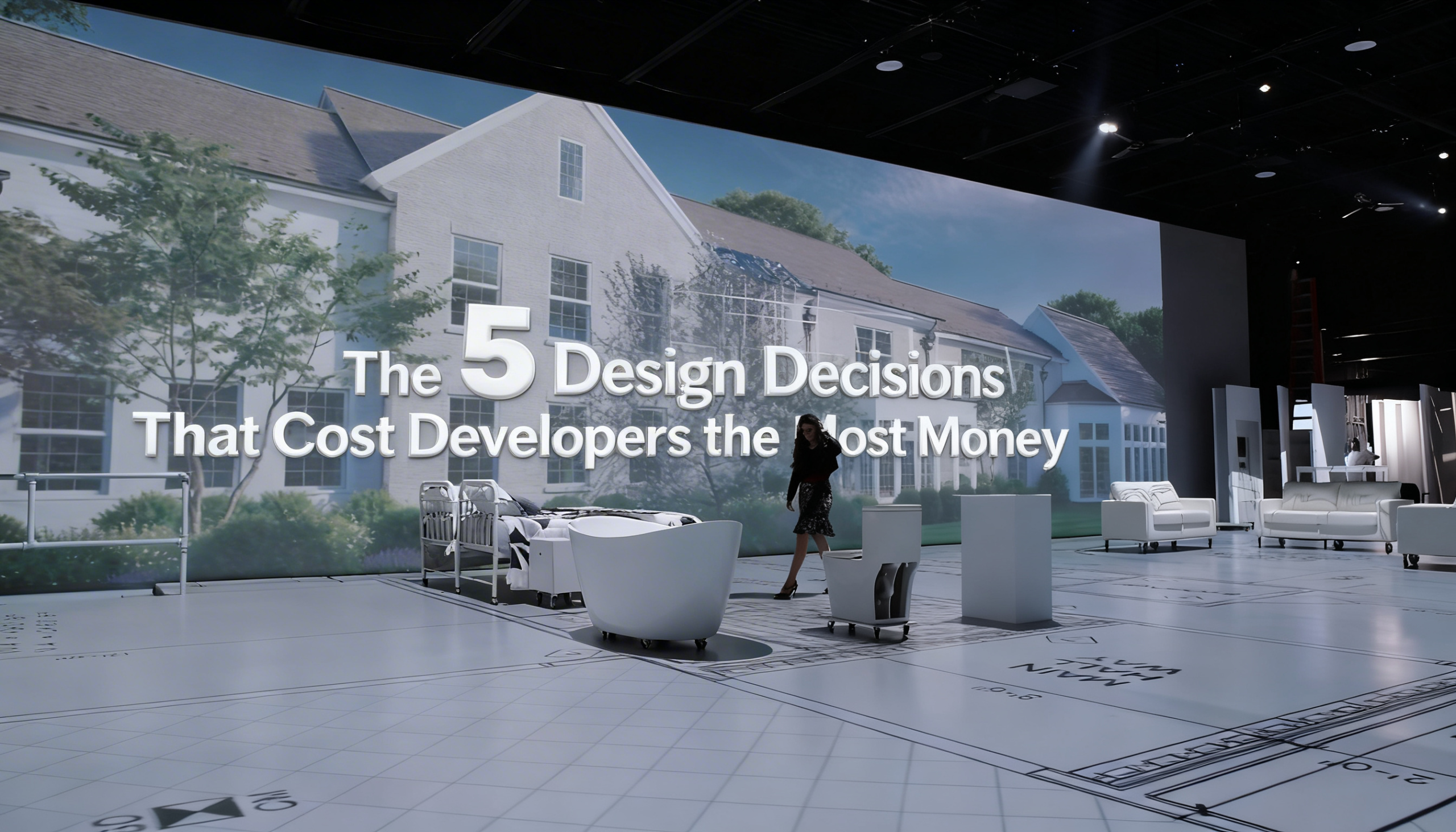
Every development project starts with numbers.
Budgets are calculated. Timelines are mapped. Returns are projected. Every decision is made with one goal in mind — maximizing value while minimizing risk.
But there’s one reality that every experienced developer understands:
The most expensive mistakes are not made during construction.
They are made before construction even begins.
These mistakes are often hidden inside the design — subtle layout inefficiencies, circulation issues, or proportion misjudgments that seem minor on paper but become costly in real life.
The good news?
Most of these construction cost mistakes can be identified early — if you know what to look for.
Why Early Design Decisions Have the Biggest Financial Impact
In development, timing is everything.
When a project is still in the design phase, changes are relatively simple. A wall can be moved. A layout can be adjusted. A room can be resized without major consequences.
But once construction begins, everything changes.
Materials are ordered. Crews are scheduled. Systems are installed.
At that point, even a small design change can create a chain reaction of delays, coordination issues, and added costs.
This is why pre construction risk reduction is one of the most important strategies for developers.
Catching design problems early is not just good practice.
It’s one of the smartest financial decisions you can make.
1. Inefficient Layout Planning
One of the most common and costly developer design errors is inefficient layout planning.
On paper, a design may look clean and organized. But in reality, inefficient layouts can waste valuable square footage, reduce usability, and impact the overall value of the project.
Examples include:
• Underutilized spaces
• Poor room proportions
• Inefficient unit layouts in multifamily projects
• Wasted circulation areas
These inefficiencies directly affect profitability.
More usable space means higher value. Less wasted space means better returns.
When developers walk through a layout at full scale, these inefficiencies become immediately visible.
They can see how the space is actually used — not just how it looks on a plan.
2. Poor Circulation and Flow
Circulation is how people move through a building.
And when circulation is poorly designed, it creates friction in everyday use.
This is one of the most overlooked architectural layout mistakes.
A hallway might be slightly too narrow. A doorway may interrupt a natural path. Rooms may not connect in a way that feels intuitive.
These issues are often subtle in drawings.
But when experienced in real space, they become obvious.
And once construction begins, fixing circulation issues can be expensive and disruptive.
Full-scale walkthroughs allow developers and architects to test movement patterns before construction, ensuring that the building flows naturally.
3. Misjudged Room Proportions
Proportion is one of the most important elements in architecture.
A room that is slightly too small can feel cramped. A room that is too large can feel inefficient or awkward.
On a floor plan, proportions are represented by numbers.
But in real life, proportions are experienced emotionally.
This is why misjudged proportions are one of the most common construction cost mistakes.
Developers may not realize that a space feels off until it is already built.
By walking through the space at full scale, they can immediately feel whether proportions are correct.
Small adjustments made early can significantly improve the quality and value of the final product.
4. Poor Sightlines and Visual Connections
Sightlines play a major role in how a space feels.
What do you see when you enter a room?
How do spaces visually connect to each other?
Does the layout feel open or closed?
Poor sightlines can make a space feel smaller, darker, or less inviting — even if the dimensions are technically correct.
These issues are often difficult to detect in drawings alone.
But during a walkthrough, developers can experience the space from a human perspective.
They can see exactly how the building reveals itself as someone moves through it.
Improving sightlines can elevate the entire design without significantly increasing cost.
5. Late Discovery of Design Conflicts
Perhaps the most expensive mistake of all is discovering design issues too late.
When problems are found during construction, they lead to:
• change orders
• schedule delays
• increased labor costs
• coordination challenges between trades
These late-stage adjustments are where projects lose time and money.
This is why identifying issues early is critical for pre construction risk reduction.
A single overlooked design conflict can have ripple effects throughout the entire project.
But when designs are validated before construction begins, these risks are dramatically reduced.
The Power of Catching Mistakes Early
The difference between a smooth project and a costly one often comes down to timing.
When issues are discovered early, solutions are simple.
When they are discovered late, solutions are expensive.
This is why developers are increasingly turning to architectural walkthrough validation as part of their process.
By experiencing the building at full scale, they can:
• identify layout inefficiencies
• test circulation and flow
• evaluate proportions
• improve sightlines
• catch design conflicts early
This approach transforms design review into a practical, real-world evaluation.
Instead of guessing how a space will feel, developers can experience it directly.
A Smarter Approach to Development in 2026
The construction industry is evolving.
Developers are no longer relying solely on drawings and renderings to make critical decisions.
They are adopting smarter tools and processes to reduce risk and improve outcomes.
Full-scale walkthrough environments are becoming one of the most effective developer planning tools available today.
They allow teams to validate designs, align with stakeholders, and move into construction with confidence.
In a world where every decision impacts cost and timeline, this extra step can make a significant difference.
Experience Your Project Before You Build
At The BluView, developers, architects, and builders can walk through their projects in a full-scale immersive environment designed for real architectural validation.
Instead of relying on drawings alone, teams can experience their layouts at life-size scale and refine their designs before construction begins.
This process helps prevent costly mistakes, improve collaboration, and protect the overall investment in the project.
Because the smartest way to build…
is to catch problems before they happen.
Visit The BluView
📍 The BluView Experience
156 Route 59, Suffern, NY 10901 – Unit B4
📞 Phone: (845) 533-4473 Ext. 101
📷 Instagram: @thebluview_experience
Schedule your walkthrough and experience your design before it becomes reality.