
If you’ve ever presented a design and heard, “I’m not sure I get it…”—you’re not alone.
It’s one of the most frustrating moments for architects, designers, and developers. You’ve spent hours refining the layout, perfecting the proportions, and visualizing every detail… yet your client still seems unsure.
Here’s the truth:
It’s not because your design is bad. And it’s not because your client lacks vision.
It’s because there’s a fundamental gap between how designs are presented… and how humans actually understand space.
At The BluView, we’ve built our entire approach around solving this exact problem.
The Hidden Gap Between Drawings and Human Perception
Architectural drawings are incredibly powerful—but they require training to interpret.
Plans, elevations, and sections are second nature to professionals. But for clients, they are:
- Abstract
- Technical
- Difficult to mentally visualize
Even 3D renderings, while helpful, are still limited. They show a moment—not an experience.
This creates a disconnect in architecture client communication, where:
- Designers think they’ve clearly explained the vision
- Clients feel uncertain but can’t articulate why
- Decisions get delayed or second-guessed
The issue isn’t communication effort—it’s communication format.
Why “Seeing” Isn’t the Same as “Understanding”
A client can look at a design and still not truly understand it.
Why?
Because understanding space is not just visual—it’s experiential.
People need to feel:
- Scale and proportion
- Movement and flow
- Transitions between spaces
- The relationship between elements
Without that, the brain struggles to convert images into real-world expectations.
This is the root of many design presentation problems.
The Cost of Misunderstanding
When clients don’t fully understand a design, it leads to:
- Hesitation during approvals
- Endless revisions and feedback loops
- Changes during construction
- Disappointment after completion
These aren’t just inconveniences—they are costly risks.
Miscommunication in architecture doesn’t just affect timelines—it affects trust, confidence, and outcomes.
Why Even Great Designers Face This Problem
This isn’t about skill level.
Even the most talented designers encounter this issue because traditional presentation methods are inherently limited.
You can:
- Explain better
- Render more
- Add more detail
But at some point, you hit a ceiling.
Because the problem isn’t clarity—it’s translation.
You’re trying to translate a real-world experience into a static format… and expecting the client to mentally rebuild it.
That’s a heavy cognitive load.
The Solution: Immersive Architectural Presentation
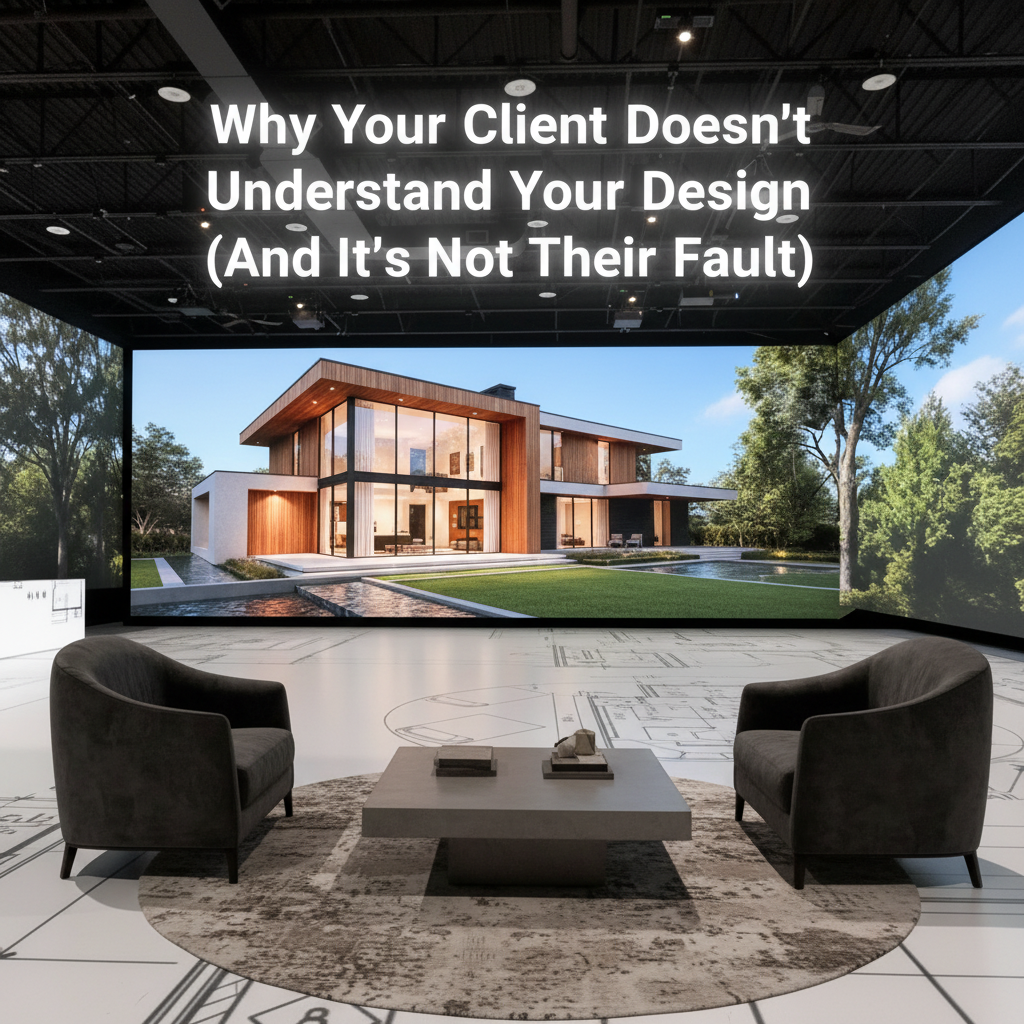
The only way to truly bridge this gap is to move beyond showing—and start immersing.
An immersive architectural presentation allows clients to:
- Walk through the space
- Experience scale in real time
- Understand flow naturally
- Feel the design before it’s built
This transforms the entire dynamic.
Instead of explaining, you demonstrate.
Instead of guessing, they experience.
Instead of uncertainty, you get clarity.
How Immersion Transforms Client Understanding
When clients experience a design, everything changes:
- Questions become more precise
- Feedback becomes more meaningful
- Decisions happen faster
- Confidence increases dramatically
This is the key to improving client understanding in architecture.
It removes ambiguity and replaces it with certainty.
From Confusion to Confidence
Think about the difference:
A client looking at a floor plan might say:
“I’m not sure how this will feel.”
The same client walking the space might say:
“This hallway feels tight—can we adjust it?”
That level of clarity is what every project needs.
Because clear understanding leads to better decisions—and better results.
The Emotional Side of Design Communication
Design is not just technical—it’s emotional.
Clients are investing in something personal, whether it’s a home, a commercial space, or a development project.
If they don’t feel confident, they won’t feel comfortable moving forward.
That’s why improving architecture client communication isn’t just about tools—it’s about trust.
When clients fully understand the design, they feel:
- Secure in their decisions
- Excited about the outcome
- Connected to the vision
And that changes everything.
The BluView Approach to Better Communication
At The BluView, we don’t just present designs—we make them understandable.
We focus on:
- Translating complex ideas into real experiences
- Eliminating guesswork for clients
- Creating clarity before construction begins
- Ensuring every decision is made with confidence
Because when clients truly understand a design, projects move faster, smoother, and with far fewer surprises.
It Was Never Their Fault
If your client doesn’t understand your design, it doesn’t mean they lack vision.
It means they haven’t experienced it yet.
Once they do, everything clicks.
That’s the shift from presenting… to communicating.
And that’s where great projects begin.