
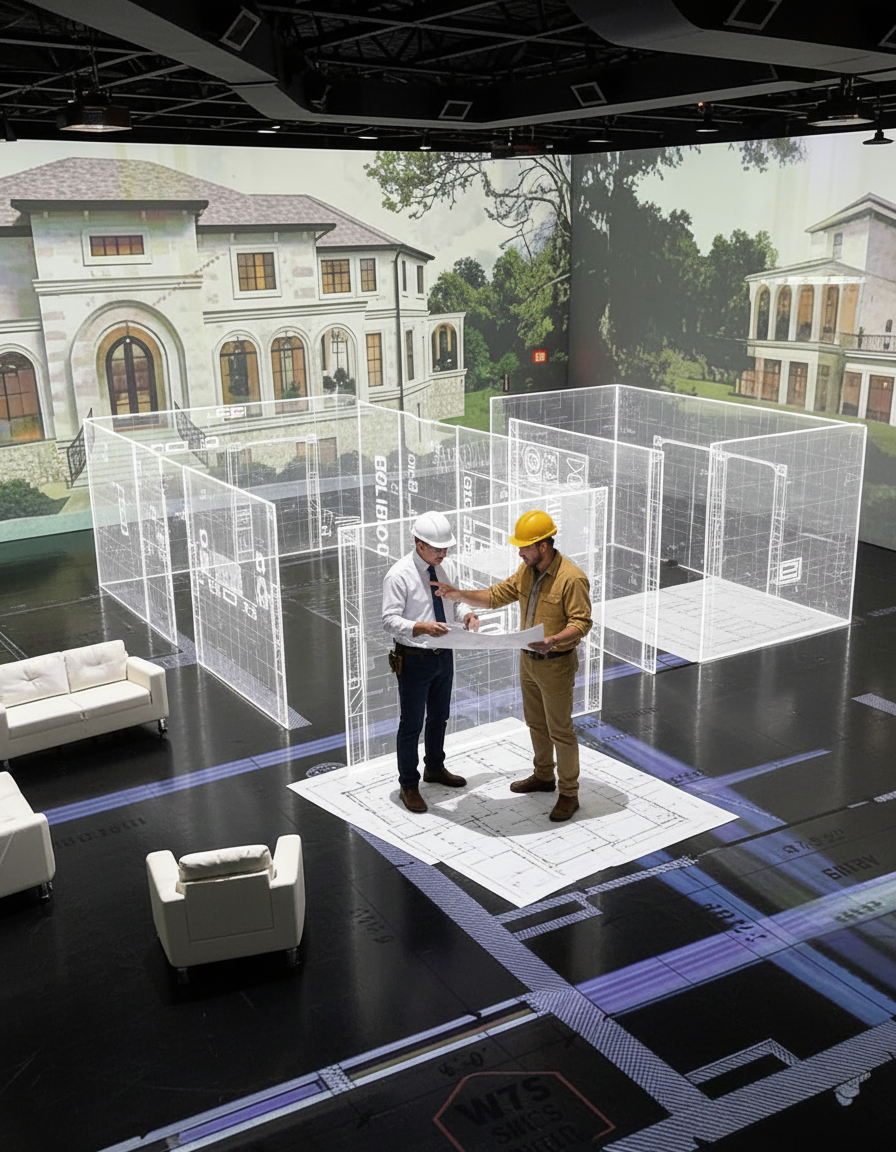
Every architectural project begins with a vision. Architects sketch ideas, develop detailed floor plans, create beautiful renderings, and carefully refine every element of the design. By the time a project is ready for construction, the plans may appear flawless.
But experienced architects and developers know something important.
Not all design problems are visible on paper.
Some of the most costly issues in architecture are invisible during the design phase. They hide within drawings, measurements, and digital models. They appear only when someone physically walks through the space.
And by the time those problems become obvious during construction, fixing them can be expensive.
This is why modern design teams are increasingly adding one critical step to the process: experiencing the building before it is built.
Why Drawings Can Hide Spatial Problems
Architectural drawings are powerful tools. They show dimensions, relationships between rooms, and structural logic. Renderings help visualize materials and lighting, while digital models allow architects to explore complex designs.
However, drawings are still representations of space.
They cannot fully replicate how a person experiences architecture through movement.
Human perception of space is influenced by factors like distance, perspective, circulation, and sightlines. These qualities often become clear only when someone physically walks through the environment.
As a result, many architectural planning errors remain hidden until construction begins.
This gap between visual representation and real spatial experience is where many building layout problems originate.
The Problem of Hallway Compression
One of the most common invisible design problems is hallway compression.
On a floor plan, a hallway may appear perfectly adequate. It meets code requirements and fits within the layout logically. The measurements check out.
But when someone walks through the space at full scale, the hallway can feel completely different.
It may feel narrow, cramped, or uncomfortable.
This sensation is not always obvious in drawings because the human body perceives spatial width differently when moving through a corridor.
Architects often notice this issue immediately during a design validation walkthrough.
A hallway that technically meets the required width may still need additional space to feel comfortable and natural.
Discovering this early allows designers to make small adjustments that significantly improve the experience of the space.
Awkward Door Placement
Another invisible design issue involves door placement.
Doors may appear perfectly positioned on architectural plans, but once experienced physically, they can interrupt circulation or create awkward movement patterns.
For example, a door may swing into an area where people naturally walk, forcing occupants to move around it. Or a doorway might open into a space where furniture placement becomes difficult.
These subtle conflicts are easy to overlook during the design phase.
But when someone walks through the environment at full scale, they become immediately noticeable.
Architects can then adjust door positions slightly to improve circulation and eliminate friction within the layout.
These small changes can dramatically enhance the usability of the space.
Poor Room Transitions
Architecture is not just about individual rooms. It is about how spaces connect.
Transitions between rooms play a major role in how comfortable and intuitive a building feels.
Sometimes a design that looks balanced on paper may create awkward transitions in real life.
For example, a narrow opening between two large rooms can create an unexpected bottleneck. A poorly positioned wall may block sightlines and make the layout feel fragmented.
These are common architectural design mistakes that are difficult to identify until the space is experienced physically.
Walking through a project reveals how rooms flow together, allowing architects to refine transitions and strengthen the overall spatial experience.
The Role of Spatial Experience in Design Validation
Architecture is fundamentally about how people experience space.
This experience includes movement, perspective, scale, and visual connection between rooms. These elements cannot always be predicted through drawings alone.
That is why design validation walkthroughs are becoming an increasingly valuable step in modern architectural planning.
By experiencing a building at full scale, architects and developers gain insights that help them refine the design before construction begins.
They can test circulation paths, evaluate spatial comfort, and confirm that the layout functions exactly as intended.
This approach helps prevent costly architectural planning errors while improving the overall quality of the design.
Why Small Problems Become Big Costs
Construction projects involve complex coordination between architects, contractors, engineers, and clients.
Once construction begins, making design changes becomes significantly more complicated.
Walls are framed. Mechanical systems are installed. Structural components are locked into place.
Even a small adjustment can trigger significant costs.
These changes often appear as construction change orders, which can affect project budgets and schedules.
By identifying invisible layout problems before construction starts, developers can avoid many of these complications.
This proactive approach helps ensure that the project moves forward smoothly.
The New Standard in Architectural Design
The architecture industry is evolving as new technologies make it easier to evaluate designs before construction.
Full-scale walkthrough environments are emerging as one of the most powerful tools for identifying hidden spatial problems.
These immersive environments allow architects and clients to experience buildings exactly as they will exist in real life.
Walls appear at full height. Rooms extend to their true dimensions. Circulation paths can be tested naturally.
Instead of imagining the space, teams can walk through it.
This shift is transforming how architects approach design validation, spatial testing, and architectural planning.
It allows teams to discover invisible problems early and refine their projects before construction begins.
Experience Your Design Before It Becomes Reality
At The BluView, architects, developers, and builders can step inside their projects through immersive, full-scale architectural walkthrough environments.
This experience allows project teams to explore layouts, test circulation, and identify hidden spatial issues before construction begins.
Instead of relying on drawings alone, teams can experience their building at life-size scale and refine the design with confidence.
This process helps prevent costly architectural design mistakes, improves collaboration between architects and clients, and ensures that buildings function exactly as intended.
Because sometimes the most important design problems are the ones you cannot see on paper.
You have to walk the space to discover them.
Visit The BluView
📍 The BluView Experience
156 Route 59, Suffern, NY 10901 – Unit B4
📞 Phone: (845) 533-4473 Ext. 101
📷 Instagram: @thebluview_experience
Experience your design before it becomes reality.