
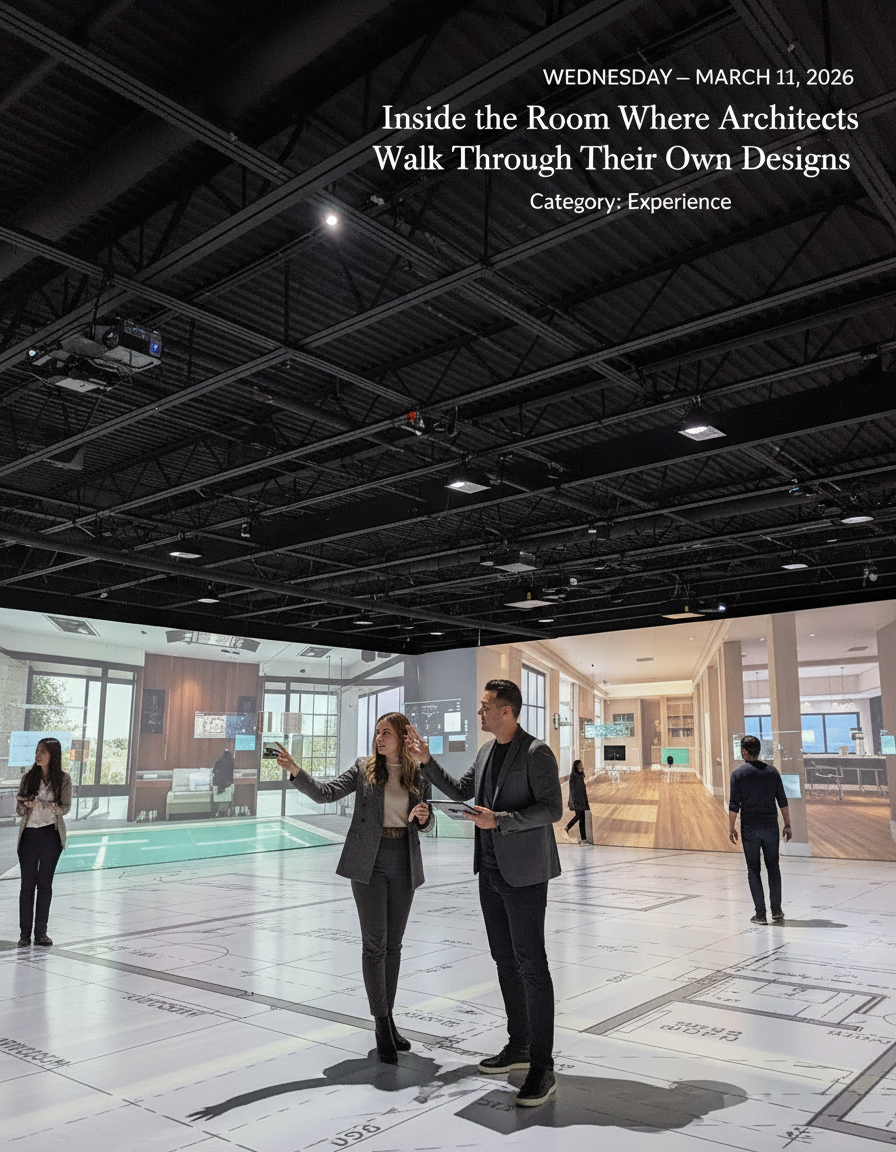
Every architect spends countless hours creating spaces that will eventually be lived in, worked in, and experienced by others. Drawings evolve, models become more refined, and renderings begin to tell the story of a future building. Yet even the most detailed design process leaves one question unanswered until construction begins:
How will this space actually feel?
For many architects, the answer used to come only after walls were built and rooms were finished. Today, however, a growing number of architects are stepping into a very different kind of environment — a place where designs are not just reviewed but physically experienced before a single brick is laid.
Welcome to the room where architects walk through their own designs.
The Moment the Drawings Become Real
When architects first enter a life-size immersive design environment, the experience is different from anything they encounter during traditional project presentations.
Instead of staring at a drawing or rotating a digital model, they are suddenly surrounded by their project. Walls appear at their true height. Rooms extend at full scale. Corridors stretch exactly as they would in the finished building.
For the first time, the design becomes spatially real.
Architects begin walking through the layout they spent months perfecting. A few steps reveal circulation patterns. Turning a corner exposes sightlines between rooms. Standing in the center of a living area shows how the space will actually feel to future occupants.
It is in this moment that architecture transitions from visual concept to lived experience.
Seeing What Drawings Can’t Show
Architectural drawings are essential tools. They define dimensions, relationships, and structural logic. But even the most detailed plans cannot fully communicate how space interacts with the human body.
When architects step into a full-scale architectural walkthrough, they quickly begin noticing details that drawings cannot reveal.
They see how far a doorway truly feels from the kitchen island.
They sense whether a hallway feels open or restrictive.
They notice how rooms connect and whether movement between them feels natural.
These discoveries are not flaws in the design process — they are simply the result of human perception. Spatial understanding becomes dramatically clearer when a design can be physically experienced.
This is why immersive walkthrough environments are rapidly becoming one of the most powerful tools in modern architectural design validation.
The Architecture Conversation Changes Instantly
Something remarkable happens when architects begin walking through their designs together.
The conversation changes.
Instead of discussing abstract measurements, architects talk about real experiences:
“Does this hallway feel wide enough?”
“Should we open this wall to create better flow?”
“What if the entry view was framed differently?”
Questions that might have taken multiple meetings to resolve can suddenly be answered within seconds.
The design process becomes faster, more collaborative, and more intuitive. Architects, developers, and clients are no longer interpreting drawings separately — they are sharing the same spatial experience.
This type of clarity dramatically improves design decision-making, project coordination, and client understanding.
Why Architects Are Embracing Experiential Design Validation
Architecture has always been about creating experiences within space. Yet the traditional design process often delays the actual experience until construction is underway.
By introducing immersive walkthrough environments earlier in the workflow, architects gain the ability to test and refine their projects while the design is still flexible.
This approach allows teams to:
• Evaluate spatial proportions at true scale
• Test circulation and movement patterns
• Verify room relationships and transitions
• Align client expectations with design reality
• Identify layout improvements before construction begins
These insights help architects move forward with greater confidence, knowing their designs have already been experienced in a realistic environment.
In an industry where late design changes can create significant delays and cost increases, this step adds enormous value to the architectural process.
The Emotional Side of Experiencing a Design
Beyond technical validation, there is also a powerful emotional element when architects step inside their own projects.
For many designers, it is the first time their vision feels truly alive.
A concept that began as a sketch suddenly surrounds them. The spatial rhythm of the building becomes visible. The atmosphere of the rooms starts to emerge.
Architects often pause in these moments, quietly evaluating the environment they created.
Sometimes they realize the design works exactly as intended.
Other times they discover opportunities to refine the layout even further.
Both outcomes are valuable, because they allow architects to strengthen their design before construction locks the project into place.
A New Step in the Architecture Process
The architecture industry is constantly evolving as new technologies and workflows improve how buildings are designed and delivered.
Full-scale immersive walkthroughs represent one of the most exciting advancements in architectural visualization and spatial testing. They bridge the gap between imagination and construction.
Instead of relying solely on drawings, models, and renderings, architects can now step directly into their projects and evaluate them through movement, perception, and real-world scale.
This approach transforms the design process from theoretical planning into experiential architecture development.
It allows architects to build with greater clarity, collaborate more effectively with clients, and ultimately deliver stronger projects.
Where This Experience Happens
At The BluView, architects, developers, and builders can walk through their designs inside a full-scale immersive environment designed specifically for architectural visualization and spatial validation.
Using advanced projection technology and life-size design environments, project teams can experience their buildings exactly as they will feel when completed.
This environment allows professionals to test layouts, refine design decisions, and communicate ideas more effectively with clients.
Instead of imagining the space, they can experience it before construction begins.
For architects, it is one of the most powerful ways to validate a design. For developers and clients, it is a clear window into the future of the project.
And for everyone involved, it turns architecture from an abstract concept into a tangible experience.
Visit The BluView
📍 The BluView Experience
156 Route 59, Suffern, NY 10901 – Unit B4
📞 Phone: (845) 533-4473 Ext. 101
📷 Instagram: @thebluview_experience
Experience your design before it becomes reality.